Game Ramblings #91 – Dragon Quest Builders 2

More Info from Square-Enix

  • Genre: Action RPG / Sandbox Builder
  • Platform: Switch
  • Also Available On: PS4

Playing this game was all sorts of breaking my usual tendencies. I would typically buy this game on PS4 for better performance, but opted for the Switch for handheld convenience. I don’t really like builders like Minecraft, but the story and goal-focused gameplay really looked interesting to me. I would typically shelve a game after reaching end credits, but I’m already hours past that point and still playing. Really I think all of those things and the quality of the core game itself have helped me to really enjoy this game a lot more than I really expected I would.
This game was a relaxing pleasure. Sometimes there’s combat, sometimes there’s building, and sometimes you just sit there and work on your community.

Where the first Builders was a sequel to Dragon Quest 1, this is a sequel to Dragon Quest 2. It picks up some time after the original game, the player becomes friends with the resurrected final boss of that game, and a buddy copy adventure ensues, with the player being the builder and Malroth being the smasher. It’s all a little bit absurd, and it provides just enough of a grounding to the DQ world to really drive the fact that this game has goals and progress and a reason to march forward.

I’ve never really been a big fan of Minecraft, which makes this game perhaps a weird target for me to play. I just never really dealt well with the open ended nature of the game, and never really felt like putting together my own list of goals to move toward. DQB2 solves a lot of that for me by providing even a small overlay of goals to head towards. I’ll just do a quick walk through of the sort of opening little bit of time in the game where you learn to build basics, learn to gather followers, and learn to farm to provide yourself food. How it works in this game is important to why it clicked more than Minecraft.
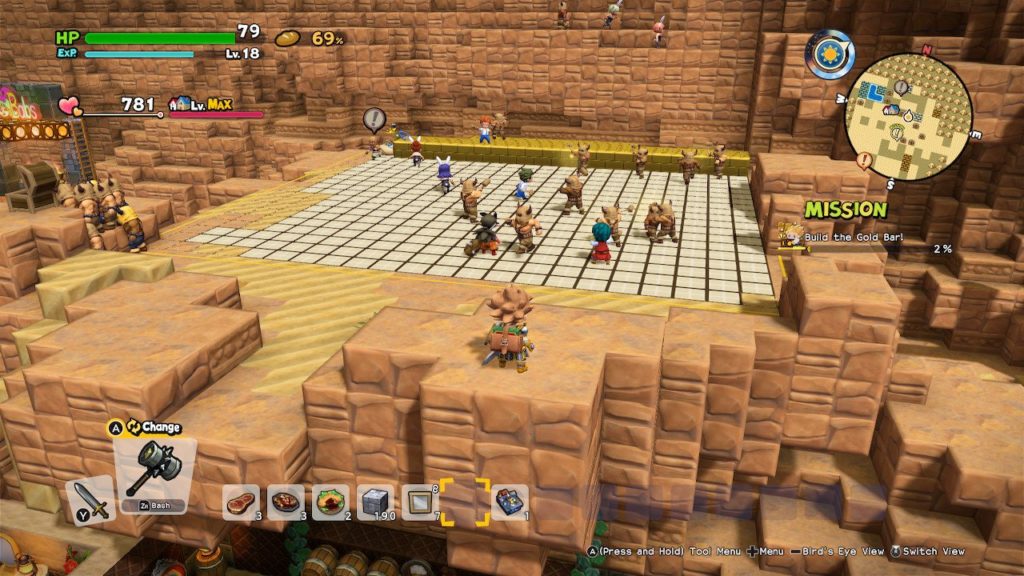
Automation through your villagers becomes super important to the improved flow of this game over your typical building-type games. Focus on what’s important next, not what you’ve already done.

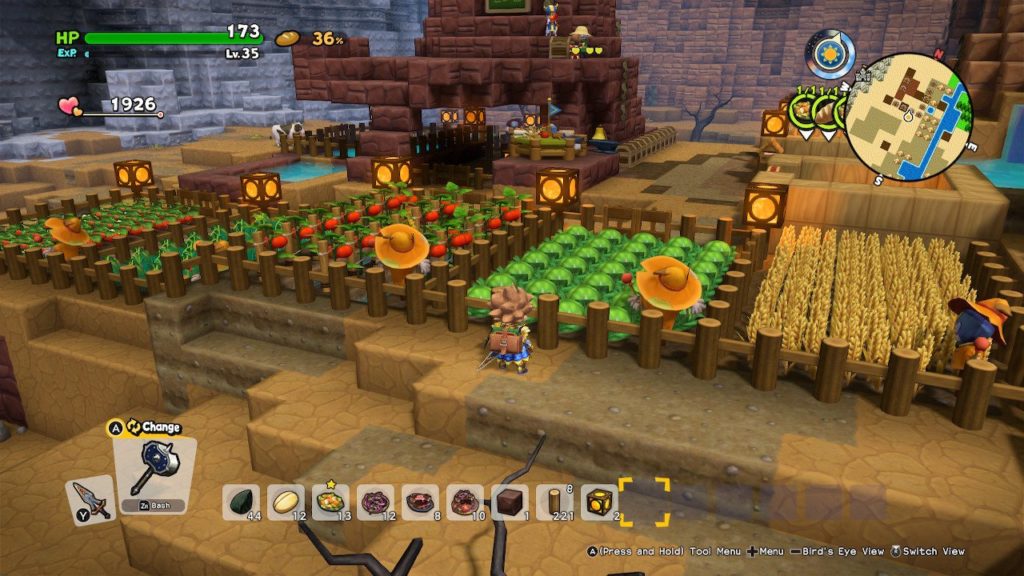
Eating to keep away from hunger is important in both games, as is the act of creating farms to sustain this growth. The first part is building farms, and importantly equipment for it. In Minecraft? You’ve got to know some recipe or figure it out, then build out some stuff with an interface that is cool to see a few times, but becomes tedious over time. In DQB2? You learn recipes and automatically batch build them in an easy to use menu. Cool, you’ve got a farm. In Minecraft? Manually grab things every time. In DQB2? Recruit followers to your island who will keep the farm in shape, plant new crops, pick grown crops, and put them in storage for you. Cool, now you’ve got some food, and can eat it raw or cook it. In Minecraft? Get on that yourself. In DQB2? Cook a thing once to learn it, then have a cooking follower do it for you, and grab from storage as needed.

I suppose the high level of all of this is that once you do something once, and it becomes automated. This allows you to focus on what’s next, instead of having an ever growing list of things that you have to do on routine. You learn to farm, setup the basics, then automate it. You later learn to mine, setup the basics, then automate it. Hell, as you start to explore smaller side islands you can gain perks that give you infinite resources of some types, which completely removes the tedious nature of having to find more and more and more of basic resources. The nature of all this is that the repetition is removed, and you’re basically focused on always doing new cool things.

The fact that this ties into a light action RPG layer also helps a lot. In general exploration, there’s simple party-based hack and slash combat. You’ve got some light gearing to provide a nice power curve. You’ve got some tools to provide enhanced exploration as the game goes on. Basically, that progression curve of action RPGs is there enough to provide a push forward. Where this really comes into play is the base defenses that grow more complex as the game goes on.
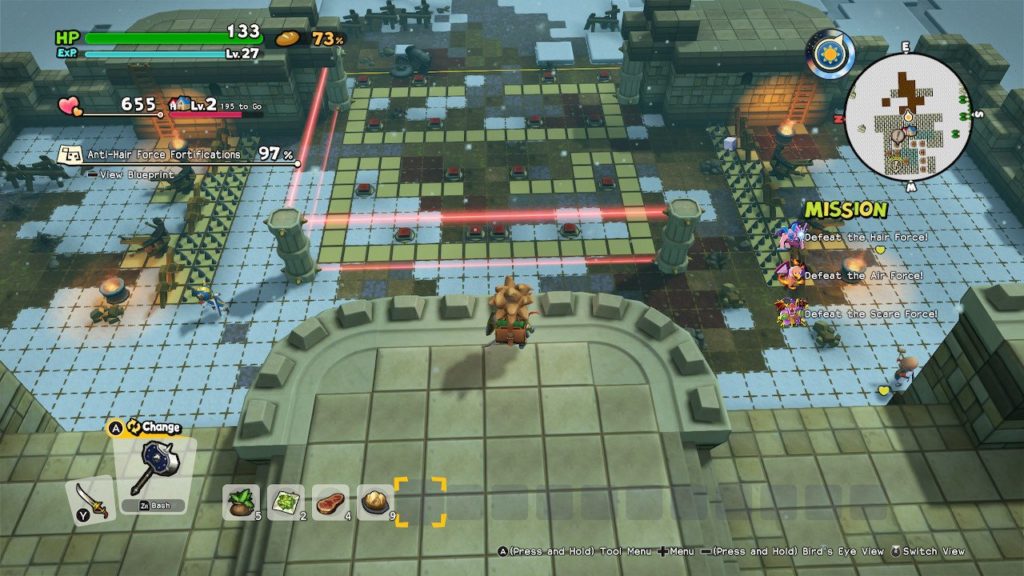
Base defense becomes really important later in the game, to the point where it becomes the focal point of a large segment of building.

The base defenses are effectively tower defense while mobile. On your side, you’ve got your base defenses and your base followers. Followers can be geared up using the same recipes used to create player gear to make them more effective. Base defenses are the real meat though. This runs the gamut from simple spikes and ballistas to more fun magic traps, whether it’s fire, wind, or ice. These provide a really fun way to meld customizing your base through the heavy builder gameplay with the combat mechanics and more typical ARPG elements. As distractions along the way they also provided periods of strategy and pace changing that broke up the monotony of exploring and digging for resources.
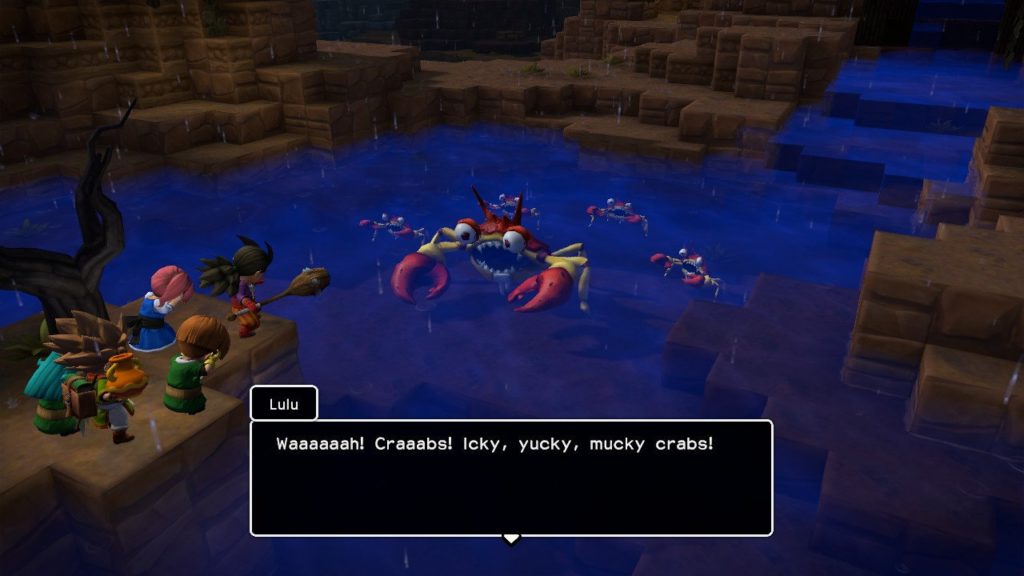
Sometimes the food even comes to you.

I think at the end of it all, I’m surprised how well just a few small changes to the core Minecraft loop got me to play the game in a different disguise. Giving me goals, giving me a story, automating monotony – those are all things that are small in theory but huge in practice. Having played the original Builders, this is also a huge push forward just for this series. The first one felt like a half step in this direction, but the sequel really smoothed out the game. It’s gone from being a neat variant on an idea to being something that I don’t want to put down, and honestly I can’t say that I saw that coming.

Game Ramblings #76 – Dragon Quest 11: Echoes of an Elusive Age

More Info from Square-Enix

  • Genre: JRPG
  • Platform: PS4
  • Also Available On: Windows, 3DS (Japan Only)

TL;DR

  • Pretty traditional turn-based JRPG typical of the series, with a few nice modern features brought in
  • Fantastically gorgeous game thanks to using UE4
  • Solid story that kept me pushing forward, even if the “true ending” path got unnecessarily grindy

I’m pretty sure  I’ve made note of the fact that I’m a sucker for JRPGs in the past, and Dragon Quest 11 is about as JRPG as it gets.  The story is nonsense, the battles are strictly turn based, the grind is real, and the characters are still default Akira Toriyama.  Despite it all, this is clearly a modernized entry in the series from the visuals to some of the little gameplay elements that improve the overall experience, and it ends up going a long way to finally bringing the series into the current generation.

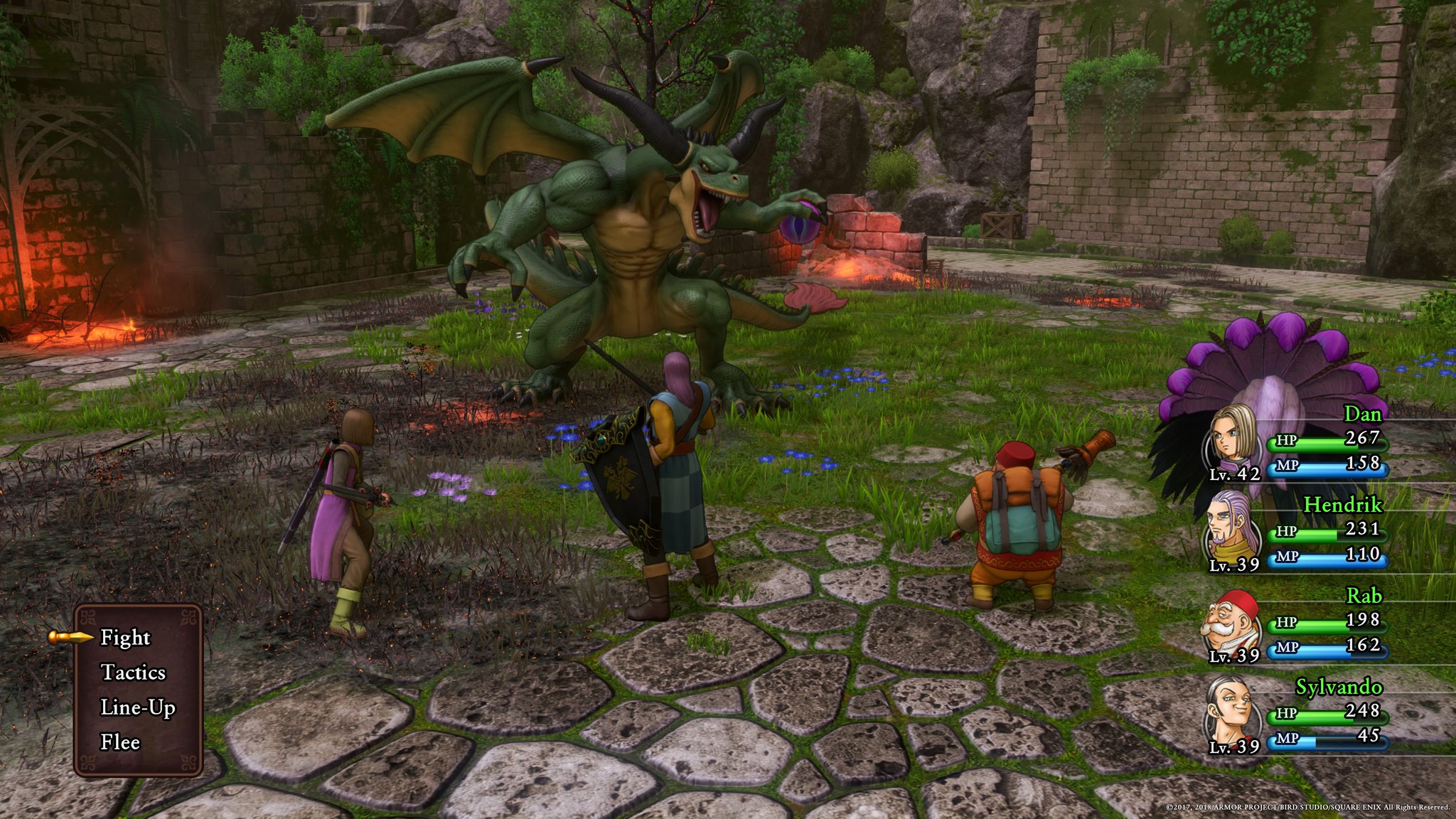
Combat is definitely familiar to traditional JRPG fans, but there’s a few nice things to minimize the tedious nature of this style.

Since this is a JRPG, I’d be remiss if I didn’t start with combat.  This is definitely a very traditional experience, even within the Dragon Quest series.  Turn order is based loosely on an effective speed stat.  Player characters have their basic attacks, skills, and magic attacks.  The general class archetypes of warrior, thief, mage, healer, etc are all present and each character definitely has their strong suit.  Behind it all is a skill tree for each character that the player can customize via skill points earned at each level.  Basically, it’s what you’d expect from a JRPG.

However, it’s the little things that this game brings that make this game an obviously more modern approach.  Auto battle makes its return from DQ9 to keep the pace of individual fights moving along.  It allows for setting priorities on how AI react, or can be turned off entirely on a per-character basis if more decision making detail is needed.  The party line up AND equipment can be changed at any time from within battle, allowing for very detailed strategies on harder content if a party or equipment setup isn’t working well.  Even more importantly, characters not in the active party gain 100% of XP from a fight, allowing the player to focus on the style that makes sense at the time without severely penalizing them for not using all characters at once.  In general, this is following a pattern of traditional but modern that is seen in a lot of other areas of the game.

I think most importantly though, this game has auto saves at pretty much every door and cutscene.  I couldn’t tell you if this was a technical or gameplay consideration, but simply knowing that I wasn’t going to lose a ton of progress to a boss death was a huge improvement to my overall play.  Rather than worrying about finding a save spot before a boss or worrying about my level, I simply always did boss fights.  Generally speaking this was fine and I would get through fights.  For a good portion of them, it also meant that I was going into fights at a challenging level, rather than grinding a bit more just to  be safe.  Overall it resulted in two really important changes to my usual JRPG game style; I did a lot less grinding so the game didn’t drag, and because of my level I was able to enjoy the challenge of level-appropriate or even underleveled fights without caring about whether I was going to die.  It may sound weird, but it just made the game more enjoyable knowing I was going to play this way.

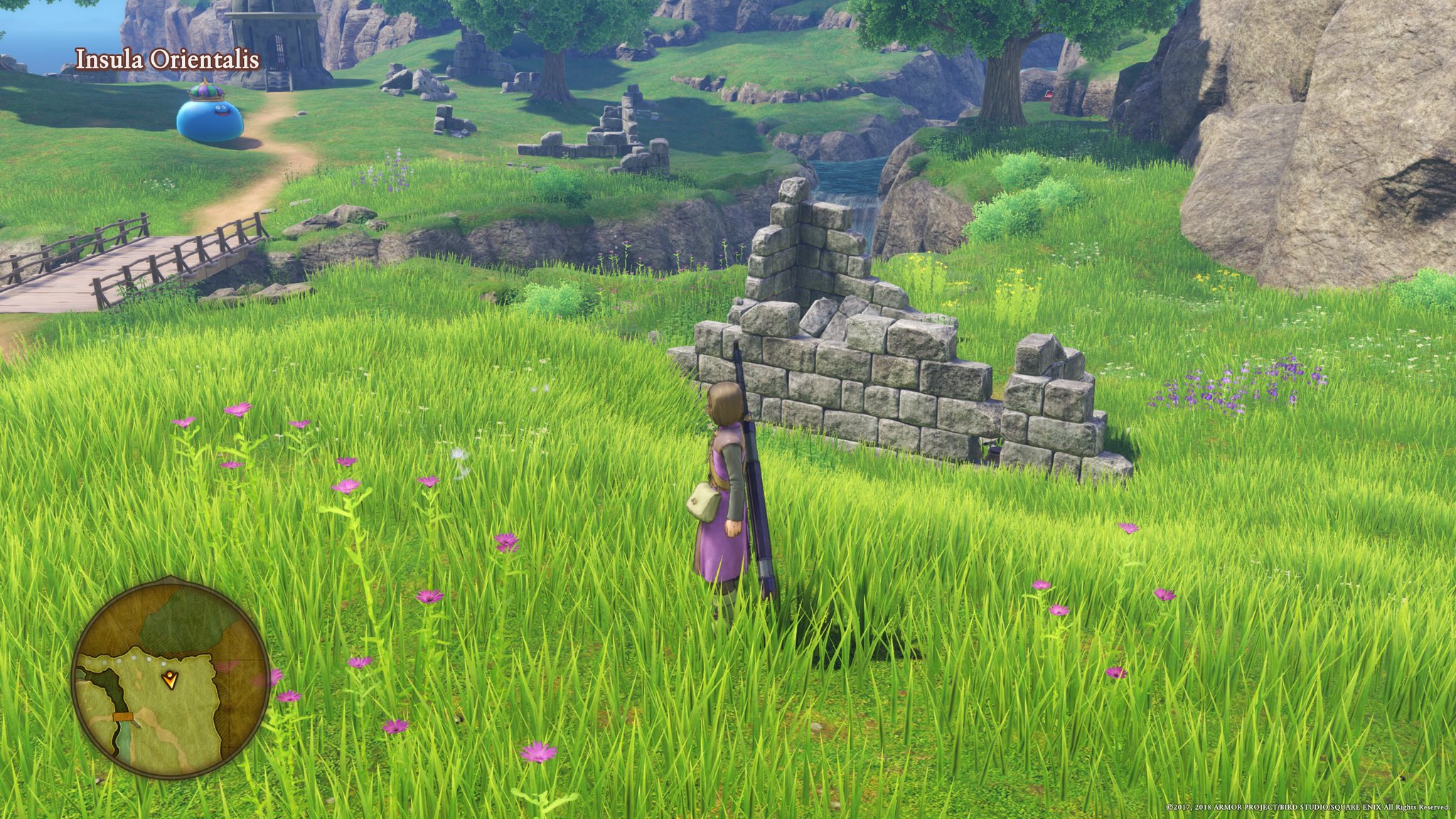
Visuals are definitely distinctly modern. It’s obviously Dragon Quest, but it’s gorgeous.

The non-gameplay elements also fit well into the traditional but modern approach.  Visually, this is probably the best looking JRPG I’ve played, hands down.  Games like Final Fantasy 15 brought the flash in an open world setting, but definitely stretched the definition of what a JRPG really is.  Dragon Quest 11 doesn’t sacrifice visuals at all while still maintaining the JRPG gameplay.  Even better, the modern style allows for all enemies to be seen in the field in ways that make sense, so there are no random battles to be seen.  On the other hand, the music side of things is very traditional Dragon Quest.  Simply put, the game uses entirely MIDI audio instead of a fully orchestrated soundtrack.  Admittedly I enjoyed the hell out of it, but I can see why it’s been rubbing some people the wrong way compared to a lot of expectations of modern games.

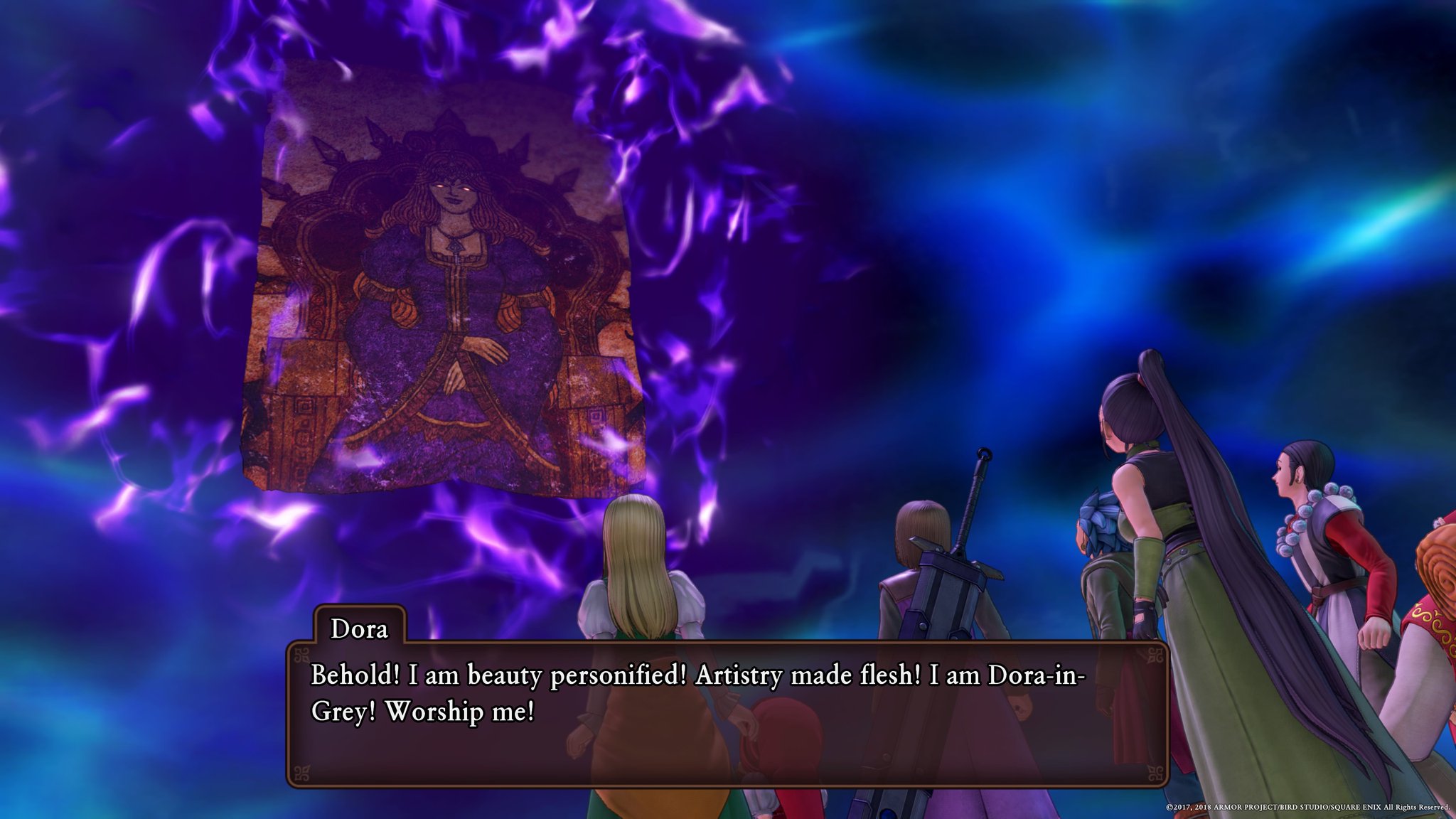
It wouldn’t be a JRPG if all bosses were serious. Sometimes you just have to fight a mural.

Overall this was a pretty enjoyable romp.  On the story front there wasn’t much new; this is still the story of a convenient hero creating a gang to take out the big world destroying baddy.  On the gameplay front it was mostly tweaks to the existing formula.  On the artistic side, it was a blend of the old and new.  However, the total package is one that really hasn’t been seen at this quality for what has been a genre moving into much different territory at the AAA level.  This may be the best example we’re going to see for a long time of a strictly turn-based JRPG, so I can’t do anything but strongly recommend it if that’s what you’re looking for.

Game Ramblings #8 – Dragon Quest VIII: Journey of the Cursed King

More Info from Square Enix

  • Genre:JRPG
  • Platform:PS2
  • Also Available On:Android, iOS, 3DS (Japan Only)

Progress

  • Full Story Completion
  • Roughly 75 hours

Dragon Quest 8 is really a classic of a very core RPG.  It has a simple turn based battle system, but a good story, entertaining characters, and decent voice acting, all in a bright and large overworld.  If someone was to point at a great example of what the core mechanics of any JRPG should start at, it would be this one.  While it hasn’t necessarily aged that gracefully in the last 10 years, it’s still a fine example of the type of JRPG that was coming out at the tail end of the PS2 era, and any fans of the genre would benefit from playing this one.

What I Liked

The gameplay overall is simple, but pretty fun.  The battle system is a standard turn-based affair.  There’s some entertaining moves, particularly Jessica who has an entire over the top sex appeal category of moves to distract enemies.  In addition, the characters can essentially save up turns to pump themselves up and do enhanced damage in subsequent moves.

Visually the game has also held up really well.  It’s similar to Wind Waker in the sense that the cel-shaded style really helped simplify the visuals of the original, but have ended up holding up a lot better than “realistic” attempts of that era.

What I Didn’t Like

Unfortunately also a stand-in of older JRPGs, there were some grindy segments of the game, particularly in the late game.  As I got to the last boss, I basically had to grind to a point where I had near-max gear, as well as three characters to revive.  Once I got the three revive, the final boss was fairly trivial, but until that point I couldn’t keep up with healing to save my life.  To some extent I expect it within the genre to have to grind, but this game felt a bit overboard.

What I Was Indifferent To

The largest side-quest thing I found was the monster arena, where special monsters you defeat in the world can battle out against each other.  There’s some good prizes to be had, but I honestly couldn’t be bothered to run around finding the strongest monsters and run back to fight them out.

There is also an alchemy system for gear and item production.  I used it a handful of times for gear, but without going to gamefaqs to come up with specific recipes it’s a lot of finding books in the world that give vague descriptions of recipes that may or may not be of any use.  Helpful for end-game gear, but really only if you know specifically what you’re trying to make.