Game Ramblings #38 – Ray Gigant

More Info from Wikipedia

  • Genre: JRPG
  • Platform: PS TV / Vita
  • Also Available On: Windows (Steam)

TL;DR

  • Decent battle system, a few changes not typical of the genre w/ move cost and HP regen made battles feel a lot more impactful
  • Battle animation was a clear focus for the visual needs of the game
  • Outside of the battle system, the game is significantly more average
  • Story works, but not much to write home about

Ray Gigant is for the most part a pretty standard first-person dungeon crawler JRPG.  It’s got a normal mapping system that generates as you wander around the dungeons.  The battles are for the most part a standard turn-based affair.  The visual-novel styled story hits a lot of points that are by and large not unusual for a sort of post-apocalyptic games out of Japan.  However, there are a few things that it does that are at least of note, even if they don’t really elevate this to anything more than average for the genre.

The biggest problem that I really had with this game is that it didn’t really do much with the dungeon crawling aspect.   The environments that I was walking through had occasional puzzles (forced teleports, one way entrances, etc), but they were never that challenging.  The art and enemies used for each story arc was the same the entire time, so once you did the first run for an arc, you knew what you were seeing.  The lack of being able to draw on the map was also a deterrent compared to 3DS games like the Etrian Odyssey series, where I could directly put traps and notes on the map as I progressed.  In general it was pretty clear that for as simple as the first-person dungeon crawling was, it was also the area that received the least amount of love, so by the end of a story arc, I was typically doing what I could just to rush through dungeons to get to the good parts.

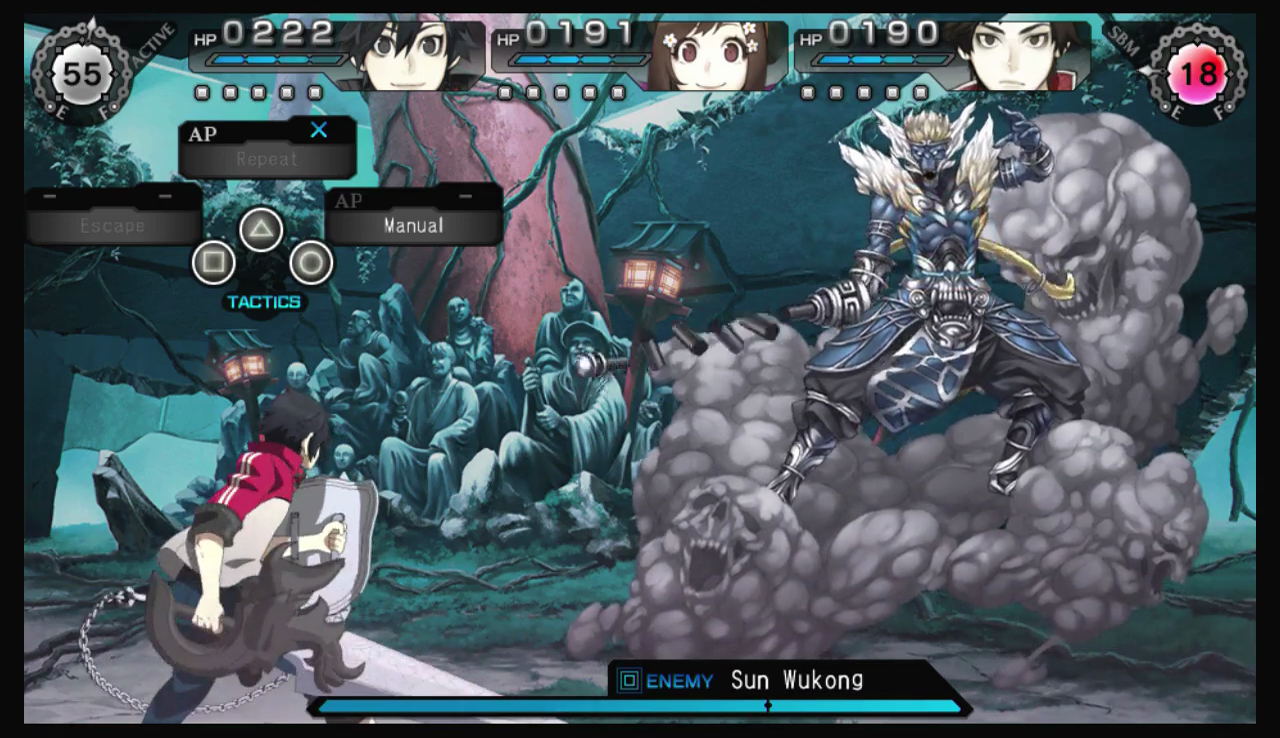
Since this is a JRPG, the core of the gameplay is in its battle system.  This is where they really do some of the things that are less standard for the genre.  There’s a pretty basic elemental system, as well as differentiation between ground, air, and undead enemies, giving a nice amount of flexibility in how you take advantage of each character’s move set to get through the battles as quick as possible.  This is backed up by everything being based on an Attack Point value, rather than a more typical mana cost.  The AP regenerates by either waiting a turn with a character, or by taking damage, so the harder battles had an interesting play between preserving AP, using heals to keep the party going, then going all out in an attack pattern to get your bulk damage in at once.  The system also resets all HP in between fights, so each fight feels more impactful, rather than becoming more of a resource-management slog that a lot of dungeon crawlers fall into.

The visual treatment of the battles is also worth noting.  All the characters have pretty decent idle animations, both the player and non-player characters.  While it doesn’t extend to the basic attack animations, it adds a nice flourish to the battle while you’re setting up your turn.

This also extends into the Slash Beat system used for a generally boss-only massive special attack.  For reasons known only to the development team, the game turns into a rhythm game at this point, but it works out shockingly well as a distraction in the middle of larger fights.

The core leveling system also takes a bit of an unexpected turn.  There’s no XP to be had at all in the game, and tied to that there are also no distinct item drops.  All fights drop one of three types of core resources, ones used for upgrading gear, ones used for purchasing skills, and ones used for purchasing character levels.  Since these drop from any fight, there’s a really quick feedback loop between the fights you’re engaging in, and the upgrades the characters receive.  It also ends up allowing for highly flexible team builds.  Taking too much damage and need defense? Spend resources into the character’s shield upgrades and get better gear, or use the skill purchase resources to get damage mitigation.  Need more attack damage? Spend resources into the character’s weapons or purchase character levels in physical damage.  Rather than being on the fairly preset path typical of most JRPGs, this feels a lot closer in style to more western RPGs, where gear builds are typically more fine grained.

However, the little details start to show where the game lacks the polish of larger budget titles.  Aside from the environment art repetition mentioned above, the story itself leaves a lot to be desired.  It pretty much follows most character tropes (broody male that doesn’t want to interact with people, airhead girl that doesn’t pay attention to things around her, obviously evil older mustached guy, etc) without going into any interesting territory.  Although there are three distinct story arcs, each one is over within a few hours, so the characters don’t have the time to grow, even if they had been written to do so.  There’s also a subsystem in battles called Parasitism that activates periodically, changing attack cost from AP to character HP.  In general it activates at inopportune times during boss battles, but can be immediately cleared with a Slash Beat attack.  It seems to serve no purpose other than linking into the story and being annoying.

Overall this was fairly average, but a nice distraction from what I’ve been playing recently.  It definitely doesn’t do anything out of the ordinary, and there are far better dungeon crawlers out there for people being introduced to the genre.  However, it scratched the itch for me without getting heavily in the way, and at least had a few nice surprises for me along the way.

Shelved It #4 – Persona 5

More Info from Atlas

  • Genre: JRPG
  • Platform: PS4
  • Also Available On: PS3

Admittedly this is a shelved it, kinda sorta.  I fully intend to play through the rest of this in some form, even if it involves just turning down the difficulty to get through boss fights.  I’m at a point where my lack of patience for the boss fight structure makes me not care about spending the effort to get through the fights, but the world that was built for this game is so good that I still feel compelled to see it.  However, given I’m bending the rules to move forward, I felt like it was worth writing about this as a normal shelving incident.

I’ve played a lot of the Megami Tensei games, whether it’s the mainline titles, Persona titles, or even tangentially related ones like Tokyo Mirage Sessions. It’s worth noting in particular that Tokyo Mirage is probably the best straight JRPG I played in 2016. The biggest core problem that I typically run into is that while the shared battle system encourages smart planning to chain moves in killing enemies, it simultaneously encourages the enemies to have extremely high damage and the same chaining abilities as a balance point. The end result is a mix of fights where the difference between an extremely easy fight and one where I get one turn wiped is one that doesn’t involve player skill at all.

In general I like the battle system that these games use.  The general setup is that you have a collection of demons with varying stats, strengths, weaknesses, and abilities, as well as core physical attacks.  By taking advantage of the range of capabilities at your disposal, you can maximize damage and knock down enemies through attacking opposition weaknesses.  In doing so, you gain extra attacks for hitting these weaknesses, giving the ability to chain attacks through the entire enemy party.  Once they are all down, the group can attack the entire opposition at once, generally resulting in a complete wipe of the enemies.  This system works fantastically well for your normal trash fights, and I could generally do most trash fights without ever being attacked, let alone taking damage.  First times against new demons up being an interesting puzzle-solving opportunity in figuring out what weaknesses can be exposed, then further fights are usually a quick mop up.  Getting through dungeons generally then becomes limited more by a lack of resources, or a need to go buy more SP items, rather than a need to run away for safety reasons.

Boss fights in the game generally involve the same fight pattern, with the obvious difference of not being able to one shot the fight.  I’d go in with some assumed set of gear that I kind of hoped would be close to functional, then either win with no trouble or wipe immediately to some form of chain attack.  If I wiped, I’d reshuffle gear, make sure I had different Personas equipped, and generally get through the phase where I died.  This cycle would continue until the boss ran out of new mechanics and I won.  My problem with this is that at no point did I feel the challenge was actually in finishing the boss fights.  It was entirely in getting arbitrary gear to block mechanics, and having no trouble once those were covered.  Rather than wipes being something that were caused by lack of skill, wipes were something I fixed by changing my accessories.  The cycle of discovery in this was not something I was doing for fun, but something I was doing because the battle system actively seeks to punish you for not having specific setups.  Once that setup is achieved, the boss fights lose their challenge, and end up being simple rotation fights that are not any different than big number trash fights.

The unfortunate thing is that the world surrounding this is fantastic.  Persona games have always been good at mixing relatively believable characters with the Japanese lore-based fantasy and this one is no exception.  The cast of characters that I had seen thus far covered a pretty wide range of personalities from your jocks to the more reserved, as well as their typical animal that talks stand-in.  The visual style, particularly within the dungeons, is also about as fantastically stylish as you’ll see in a JRPG.  This is backed by another fantastic soundtrack that pretty seamlessly flows between rock and acid jazz to fit the situation.  On its own I don’t know that we’re going to see another game this year that will be so iconic in its visual and audio design as Persona 5.

Ultimately I’m not that surprised I’m at this point.  Since I’ve played this series before, I knew what my problems were going to be with the battle system going in.  I guess if there’s anything I’m surprised about, it’s that I’ve already hit the point where I stopped caring without being anywhere near the finish.

Game Ramblings #32 – Tales of Berseria

More Info from Bandai Namco

  • Platform: PS4
  • Genre: JRPG
  • Also Available On: Steam, PS3 (Japan Only)

The Tales of series has been going on for a long time.  Most people’s familiarity with it is directly tied with the GameCube release of Symphonia, but that’s just one of many main line titles in the series.  Berseria in a lot of ways feels like a final act in the PS3 game line and a natural progression of the PS3 titles starting with Xillia.  With this being a direct universe prequel to Zestiria this makes quite a bit of sense.  However, there’s been a number of changes that have pushed the gameplay ever further towards a direct action RPG style.

The biggest high level difference long time Tales of players will notice is that this story is decidedly darker than your typical titles in the series.  The surface level of the story is very direct with this in that you are playing the bad guys.  At its core, your group is basically out to destroy the world, even if their motives are somewhat more selfish than that.  However, beyond the surface layer, there are a number of themes that play on negative psychological aspects that I was surprised to see in such detail.  All that said, the progression and ultimate redemption of the party in the final act is worth the pay off.  Players of Zestiria will also connect a lot of dots about how the game’s shared universe works, and the return of a handful of characters from the previous title adds a nice layer of depth to the universe, even though the thousand year gap between the two games means they are largely disconnected from each other.

At a gameplay level, things are largely as they have been for a while, with some key differences once the battle system is reached.  Like Zestiria and the Xillia titles, there is no distinction between dungeons and a larger scale overworld.  Everything is interconnected using realistic scale environments, so moving between towns, fields, and dungeons is fairly direct.  The environments are scattered with non-random battles that start with interacting with enemies.  There are also your standard assortment of treasure chests, as well as the return of herbs and item spheres that can be collected around.  The only new addition to item pick ups are Katt souls, which serve as a secondary currency for unlocking some specific chests largely filled with outfits and visual accessories.  The end result is that if you’ve played a Tales of  game on PS3 in the last 5 years, you know what you’re getting into here.

Battles are where the gameplay has changed the most.  Pretty much every Tales of game in the past has had standard attacks on one face button, and Artes attacks using a secondary resource on another face button.  This is all gone.  For one thing, all attacks are now set by the player across the four face buttons based on a position within a combo chain.  All attacks and artes now using a single resources that determines how many attacks can be chained in a single combo.  The resource stack grows by applying negative conditions to enemies or properly timing dodges, and shrinks when negative conditions are applied to the player.  With 3+ resources available, the player can also activate a special overdrive-like mode or special attacks, depending on the character, giving a boost to damage as well as a significant heal.  Because of the constant back and forth in changing the active combo length, as well as the layout of the custom combos, the game feels very distinctly like a 3D fighting game in battle.  While these titles have always been very action-focused, the changes here have pushed the game in a direction that is a distinctly fresh take on the gameplay, even if a lot of the core pieces are very recognizable to returning players.

Also of note to the core gameplay loop are some changes to the gearing system.  Stats are still very much there, but the most important aspect to gear is a mastery stat.  Every piece of gear has a mastery stat, which can be anything from flat stats (+x Defense, etc), to type-specific increases (+x% damage to undead), to very specific effects around status conditions (-x% time to applied poisons).  Once an item mastery has been earned, it is permanently applied to the character.  Because of this change, I was typically wearing whatever gear was not mastered, rather than whatever gear was the best.  By the end of the game, the summation of all these individual masteries was easily more important than changes in stats between two pieces of gear, so I was constantly searching both in shops as I got to them, as well as for treasure chests in all the environment areas for new gear that I hadn’t seen before.

Given that we haven’t heard anything about the next Tales of title, my assumption is that they’re now digging in to get going on the true next-gen progression of the series.  While Zestiria and Berseria were on PS4, they were direct ports from PS3 titles released at the same time.  Given the departure that the PS3 titles were from some of the past games, I can only assume that we’re going to see a similar change in gameplay for whatever the next title will be.  However, it feels like the changes have already started here.  The action focus of the battle system is a very distinctly new feel to the series, even if a lot of the core pieces feel the same.  Because of the constant healing and changes to gear mastery, the game felt more focused than ever on the core combo-based action, rather than the number crunching typical of most JRPGs.  Like Final Fantasy 15, it feels like they’re moving further away from what started the series’ popularity, but like FF 15, I’m also pretty confident it’s for the best.  Technology has progressed to the point where we can have the grand adventures, as well as fast paced gameplay, and I feel like we’re only scratching the surface of where this series will be going in the future.