Game Ramblings #76 – Dragon Quest 11: Echoes of an Elusive Age

More Info from Square-Enix

  • Genre: JRPG
  • Platform: PS4
  • Also Available On: Windows, 3DS (Japan Only)

TL;DR

  • Pretty traditional turn-based JRPG typical of the series, with a few nice modern features brought in
  • Fantastically gorgeous game thanks to using UE4
  • Solid story that kept me pushing forward, even if the “true ending” path got unnecessarily grindy

I’m pretty sure  I’ve made note of the fact that I’m a sucker for JRPGs in the past, and Dragon Quest 11 is about as JRPG as it gets.  The story is nonsense, the battles are strictly turn based, the grind is real, and the characters are still default Akira Toriyama.  Despite it all, this is clearly a modernized entry in the series from the visuals to some of the little gameplay elements that improve the overall experience, and it ends up going a long way to finally bringing the series into the current generation.

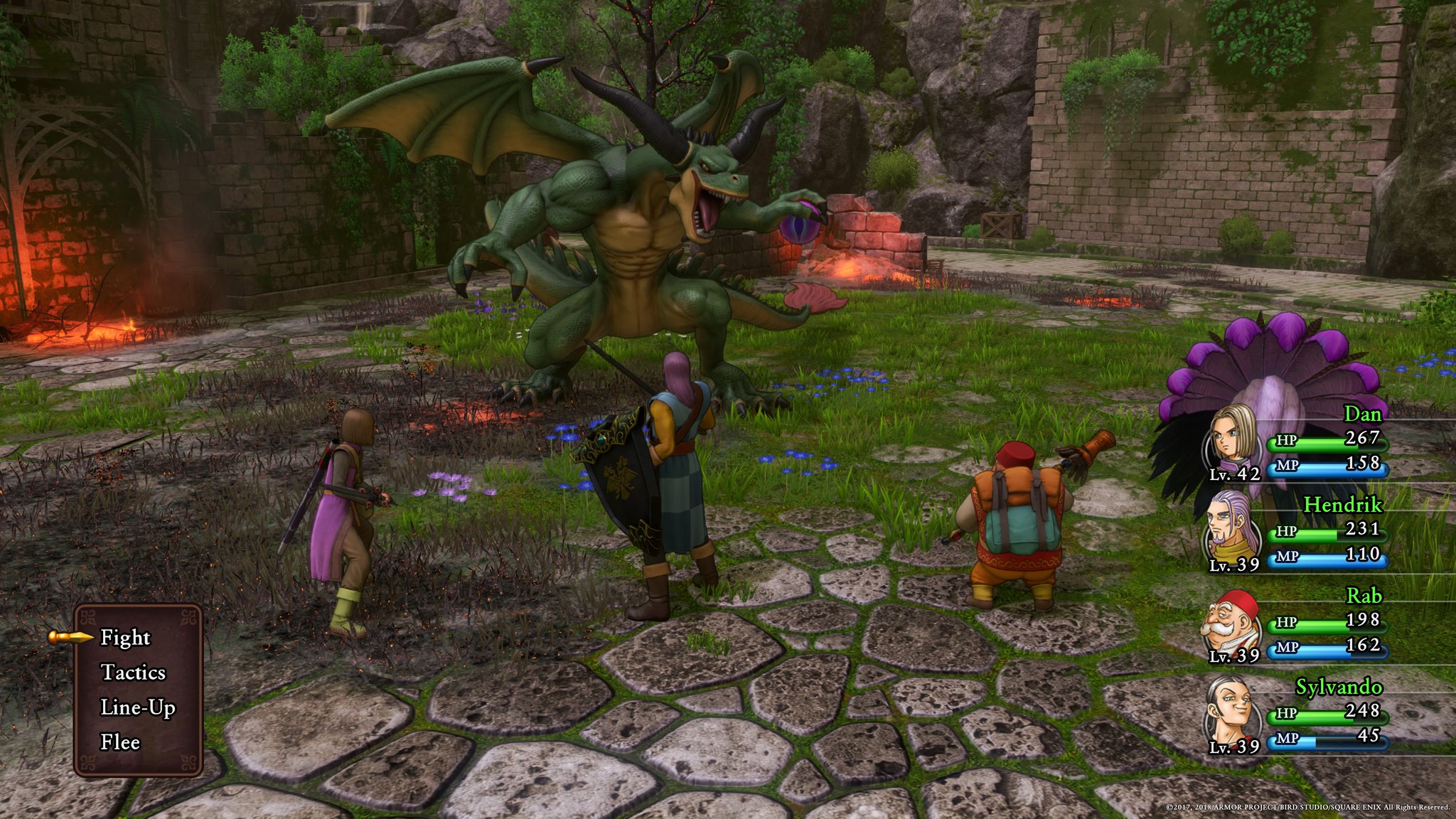
Combat is definitely familiar to traditional JRPG fans, but there’s a few nice things to minimize the tedious nature of this style.

Since this is a JRPG, I’d be remiss if I didn’t start with combat.  This is definitely a very traditional experience, even within the Dragon Quest series.  Turn order is based loosely on an effective speed stat.  Player characters have their basic attacks, skills, and magic attacks.  The general class archetypes of warrior, thief, mage, healer, etc are all present and each character definitely has their strong suit.  Behind it all is a skill tree for each character that the player can customize via skill points earned at each level.  Basically, it’s what you’d expect from a JRPG.

However, it’s the little things that this game brings that make this game an obviously more modern approach.  Auto battle makes its return from DQ9 to keep the pace of individual fights moving along.  It allows for setting priorities on how AI react, or can be turned off entirely on a per-character basis if more decision making detail is needed.  The party line up AND equipment can be changed at any time from within battle, allowing for very detailed strategies on harder content if a party or equipment setup isn’t working well.  Even more importantly, characters not in the active party gain 100% of XP from a fight, allowing the player to focus on the style that makes sense at the time without severely penalizing them for not using all characters at once.  In general, this is following a pattern of traditional but modern that is seen in a lot of other areas of the game.

I think most importantly though, this game has auto saves at pretty much every door and cutscene.  I couldn’t tell you if this was a technical or gameplay consideration, but simply knowing that I wasn’t going to lose a ton of progress to a boss death was a huge improvement to my overall play.  Rather than worrying about finding a save spot before a boss or worrying about my level, I simply always did boss fights.  Generally speaking this was fine and I would get through fights.  For a good portion of them, it also meant that I was going into fights at a challenging level, rather than grinding a bit more just to  be safe.  Overall it resulted in two really important changes to my usual JRPG game style; I did a lot less grinding so the game didn’t drag, and because of my level I was able to enjoy the challenge of level-appropriate or even underleveled fights without caring about whether I was going to die.  It may sound weird, but it just made the game more enjoyable knowing I was going to play this way.

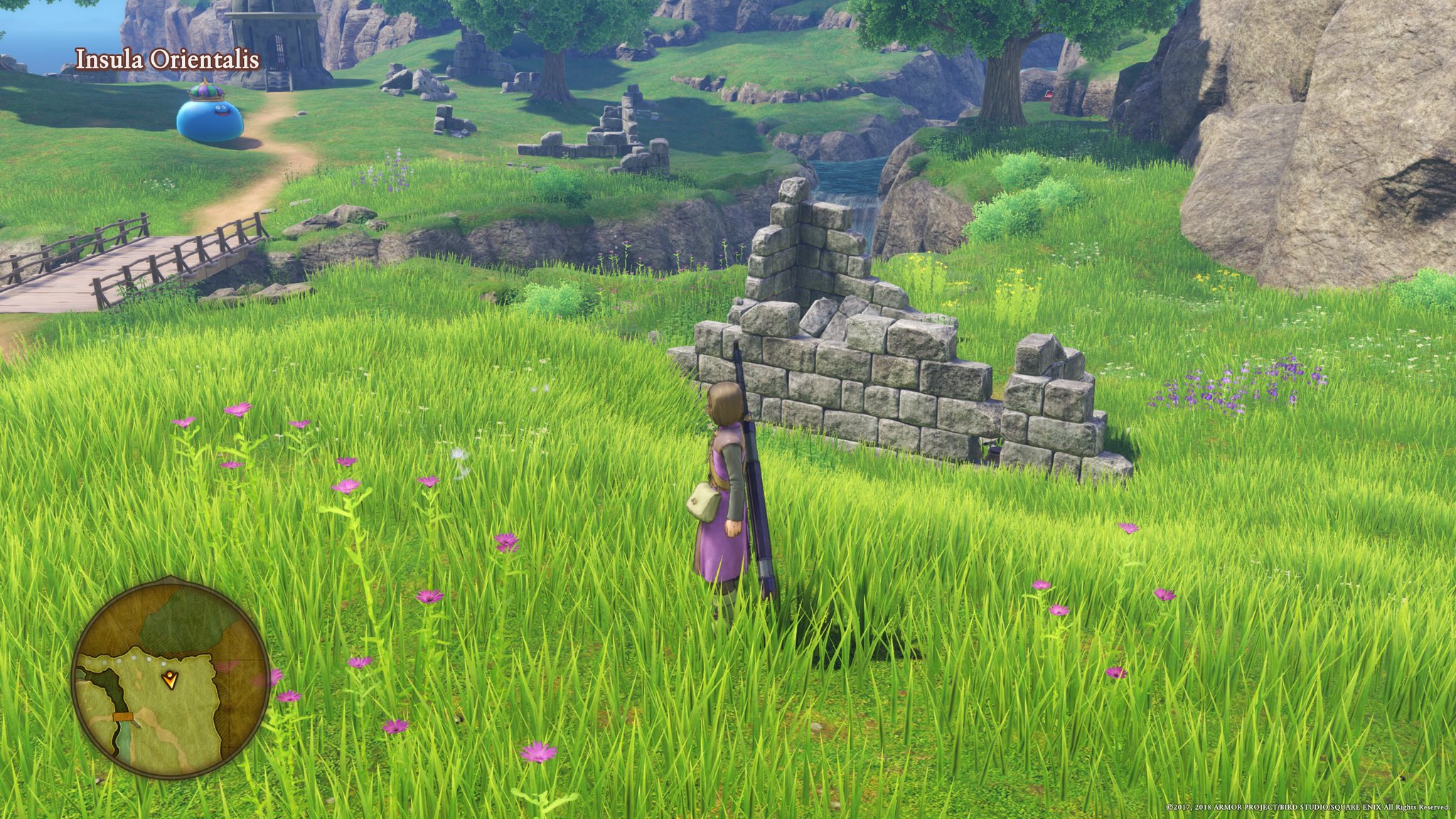
Visuals are definitely distinctly modern. It’s obviously Dragon Quest, but it’s gorgeous.

The non-gameplay elements also fit well into the traditional but modern approach.  Visually, this is probably the best looking JRPG I’ve played, hands down.  Games like Final Fantasy 15 brought the flash in an open world setting, but definitely stretched the definition of what a JRPG really is.  Dragon Quest 11 doesn’t sacrifice visuals at all while still maintaining the JRPG gameplay.  Even better, the modern style allows for all enemies to be seen in the field in ways that make sense, so there are no random battles to be seen.  On the other hand, the music side of things is very traditional Dragon Quest.  Simply put, the game uses entirely MIDI audio instead of a fully orchestrated soundtrack.  Admittedly I enjoyed the hell out of it, but I can see why it’s been rubbing some people the wrong way compared to a lot of expectations of modern games.

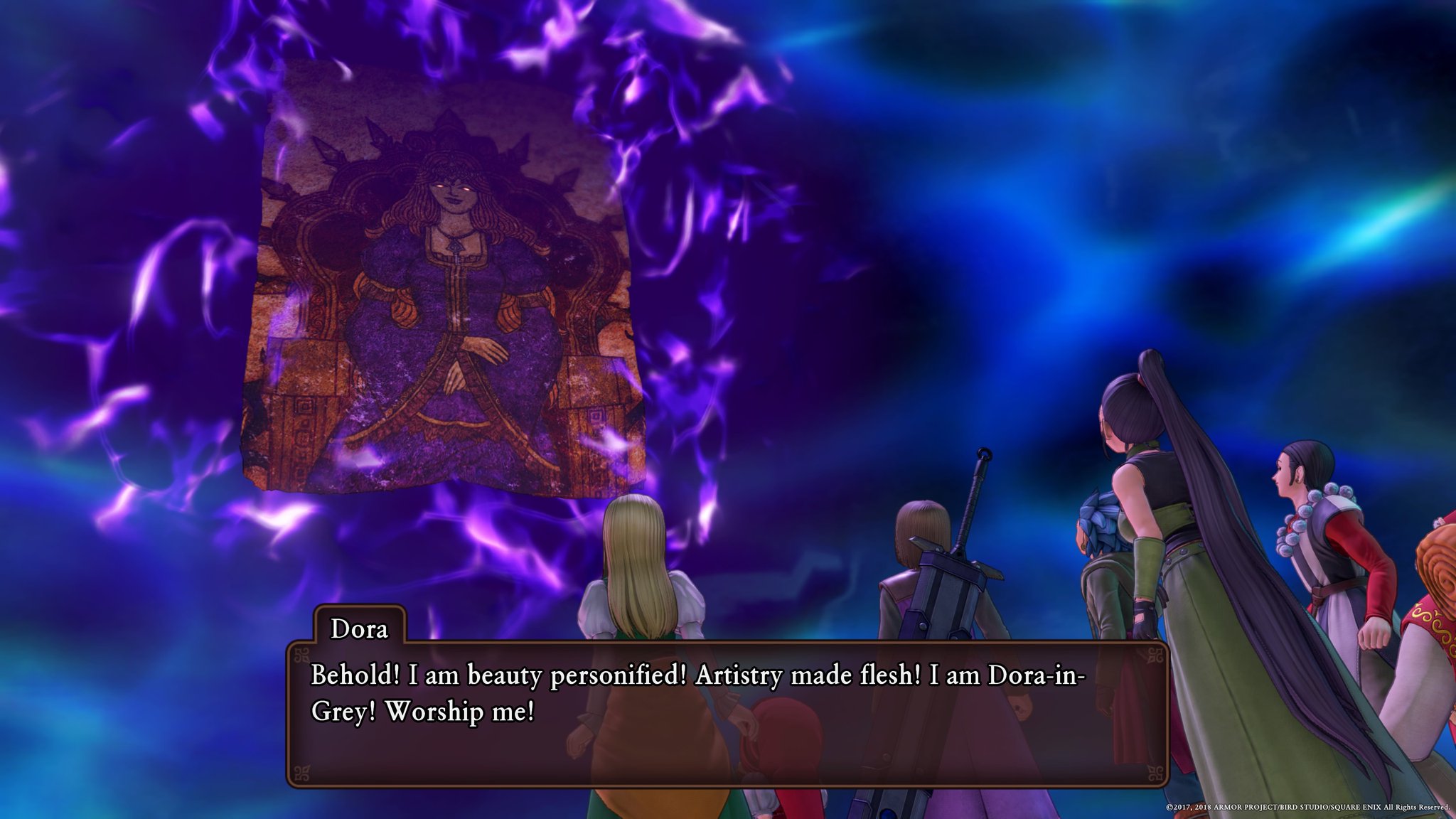
It wouldn’t be a JRPG if all bosses were serious. Sometimes you just have to fight a mural.

Overall this was a pretty enjoyable romp.  On the story front there wasn’t much new; this is still the story of a convenient hero creating a gang to take out the big world destroying baddy.  On the gameplay front it was mostly tweaks to the existing formula.  On the artistic side, it was a blend of the old and new.  However, the total package is one that really hasn’t been seen at this quality for what has been a genre moving into much different territory at the AAA level.  This may be the best example we’re going to see for a long time of a strictly turn-based JRPG, so I can’t do anything but strongly recommend it if that’s what you’re looking for.

Game Ramblings #67 – Radiant Historia: Perfect Chronology

More Info from Atlus

  • Genre: JRPG
  • Platform: 3DS
  • Original Released on: DS

TL;DR

  • Still one of the more interesting JRPG battle systems I’ve ever seen with a heavy emphasis on moving and grouping enemies for AoE attacks.
  • Good selection of new content for returning players that is well integrated into the mainline story for new players.
  • Doesn’t do anything to inherently fix the grind of the original game, but a new Friendly difficulty opens up some interesting potential for JRPGs to pull from.

Admittedly this is a game I shelved the first time around.  It’s not that it was bad; in fact its battle system alone makes this game at least worth checking out.  However, in the base difficulty this game is EXTREMELY grindy.  Fights are mechanically interesting, but can be slow.  Damage is large, so healing is often necessary.  Healing burns mana, so items are necessary.  Items cost money, so money is necessary.  Running out of money necessitates more fighting, so you’re stuck in a loop.  Generally speaking, it wasn’t even the bosses that were an inherent problem.  It was usually just getting to the point where taking out trash in a new chapter felt reasonable without being a huge risk.

So, does the remake solve that? Nope.  Does it do anything to really change the game mechanically?  Nope.  What it does so is add a new Friendly difficulty that is entirely too easy, but brings in some really interesting mechanics to eliminate the need to grind, and is something I hope to see more games explore in the future.

Combat is the core of any JRPG and this one is no different, cleverly mixing traditional turn-based mechanics with some tactical positioning systems.

Since this is a JRPG, I feel like I should start off with combat as it was and still is one of the strong points of this game.  Radiant Historia pretty cleverly mixes pretty standard JRPG mechanics with a very tactics-styled positioning system into a quick hitting system where the focus becomes trying to maximize stacking of enemies to allow for multiple hits in one attack.

While the core system has your standards (basic attacks, magic attacks, heals, buffs/debuffs, etc), the real core of the system is in repositioning attacks.  Pretty early on all the party characters gain attacks that can move enemies around the board.  Enemies that are repositioned into each other are then treated as single units for purposes of attack location, allowing for stacked enemies to all be damaged at one time.  This then combines with turn order manipulation, either via speed stat, skills to delay turns, etc to chain friendly attacks, and the real focus comes down to basically trying to stack all enemies at once into a single spot and unleashing hell.

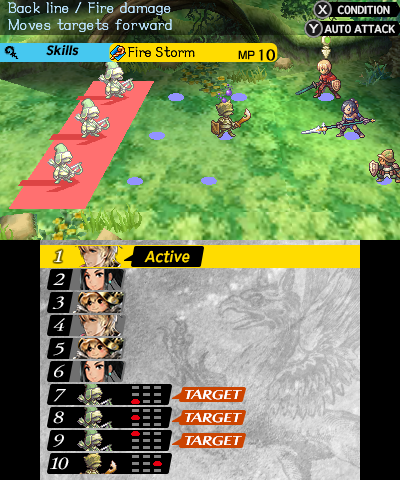
As an example, in the screenshot above, I could use Fire Storm to move the whole back line forward, then use line attacks to kill all 4 enemies at once.  Alternatively, I could push the front guy back and do the same against the full back line.  Other bonuses come into play (front line takes more damage but also does more damage) to allow for more nuanced strategies over the course of a full fight, but the core is in smart positioning for maximizing damage output.

All of these things elevate what would be a typically standard battle system into something truly special, and even in the grindy areas of the game allow for a lot of fun, particularly with the on-the-go nature of the DS family, allowing for a few interesting battles in a few minutes if that’s all the time the player has.

The core of the game is about free wheeling through time, with events in one timeline causing ripple effects on the other.

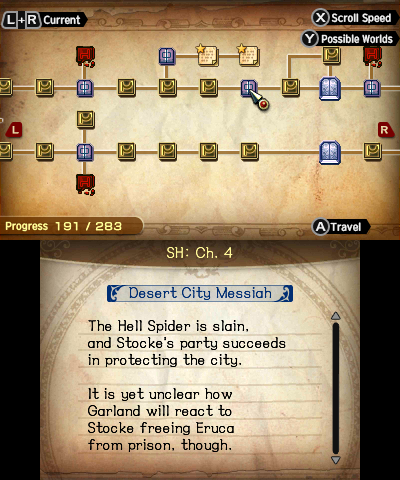
On the story side, this game is entirely about manipulation of time.  The game takes place in a split timeline where you have unlimited attempts to set things right, so dying is really not a huge deterrent.  However, each timeline has its own problems to solve, and problems that can unblock progress in the other timeline.  In addition, there are distinct losing points (red nodes in the above) where the story progress effectively ends, forcing a restart at the nearest chapter.

Overall this works as a good way for the player to have freedom in their choices.  Hit a block in the story and can’t figure it out? Find a spot where a new side path can be completed elsewhere in the timeline, and you might be able to unblock things.  Difficulty spike means you need to level up a bit? Jump back to an earlier point in the timeline where battle grinding is more practical.  The freedom of choice to jump around like that is a thing that a lot of JRPGs don’t really give, and its an effective tool here when combined with the story background of jumping through time.

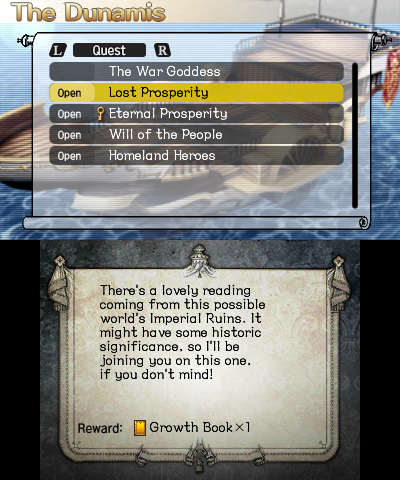
The Dunamis runs the set of side histories, adding new potential futures for the characters, as well as some additional back story to the world.

This is all maintained really well in the remake, and is padded by some additional new content both in the main timeline and in a new set of side stories labeled as possible histories.  For returning players, this is the bulk of the content that they’ll be coming back for.  While these aren’t story bits tied to the main line, they’re an interesting look at what could have been within the overall structure of the world.  In addition, the woman running the Dunamis also provides a path to learning more about the history of the world the game takes place in, opening a path for some more interesting lore.  However, this alone wouldn’t have been enough for me to come back for more grinding.  The addition of Friendly mode was the real thing that brought me back.

The entire idea behind Friendly mode is that it provides a path for the player to skip unimportant battles.  In the base game, if the player hits a unit on the field, they gain a preemptive strike to allow them to attack first in battle.  While this was helpful, it didn’t eliminate the need to spend resources while grinding.  Friendly mode takes this one gigantic step further.  In this mode, if the user strikes an enemy in the field, they automatically win the battle, gain XP, and gain all relevant resources that would have normally dropped.  The end result of this is that the only combat the player ever takes place in will be for boss battles and story-relevant battles, leaving the rest of the game to exist as a way to enjoy the story and figure out the time-based puzzles.

I’ve seen this mode described as the visual-novel version, and I think that’s about as close to accurate as I could come up with.  The game becomes significantly shorter in this mode, and the story comes at a much more rapid pace, so I found myself being significantly more involved in enjoying the story as it came at me, rather than having huge grinding delays between story segments.  It then felt even more important to be in battle, as it always felt like it served the story at that particular time, rather than being a consequence of needing to level up the party.

End of the day, I think this is something that more JRPGs should explore as a core feature going forward.  The reduction in grind meant the game flowed much quicker and I never lost the story.  If I WANTED to battle, I could also simply run into an enemy on the field and start battle, but it was a conscious choice.  The one real downfall of Friendly mode is that it was also combined with an extremely lowered difficulty.  Ideally, the Friendly mechanics would be combined with boss battles that are tied to the selected difficulty, leaving the challenge there where the player wants with the streamlined battle selection.  However, for a returning player simply wanting to see the story, I think the lowered difficulty ended up being pretty ideal for me in most areas.

I guess this is a pretty easy one for me.  This was a great game when it originally came out, and it’s a great game now.  The problems that existed are still there, so if you’re a new player be ready for some grinding.  If you’re a returning player, this is a <20 hour run with the addition of Friendly mode, allowing for the focus to be on enjoying the narrative.  However, I think there’s enough there for anyone to enjoy to generally recommend it, assuming of course you haven’t sold off your 3DS.

Game Ramblings #62 – Xenoblade Chronicles 2

More Info from Nintendo

  • Genre: JRPG
  • Platform: Switch

TL;DR

  • Visually spectacular JRPG filled with large monsters and even larger environments
  • Overly complicated level and gearing systems that could have worked much better if the UI wasn’t so frustrating
  • Solid battle system that has been smartly streamlined since the previous titles, but still has late-game issues with overuse of one-hit mechanics

I’m going to open with what nearly had me shelving the game, because it was the same type of weird late-game design pattern that plagued both Xenoblade and Xenoblade X.  For reference, I was at 84 hours in and on the final sort of boss run before the end of the game.  That late into the game is not the kind of place you want to turn the design on its head.

Throughout the game, I had basically setup my party to where I was a DPS/off heal, one of my characters was a full time tank, and my third was rotating between pure DPS and mixed tank/heal, depending on my needs.  Basically, the main character was in no way setup to actually BE a tank, but that’s what the end game expects of you.

The TL;DR without spoilers is that your entire party gets taken away, and two of the main blades that you develop through the story get taken away, leaving the main character on his own to fight a chain of 1v1 boss battles, without the two blades I’d built my gameplay style around, and needing me to scrounge together what blades I had to try and bullshit my way through the boss fights.  Looking on Gamefaqs and looking at my roster I barely had what I needed leaving me with one choice; bullshit around mechanics to get through it.

I threw on two hammer tanks that have a shield move containing major block percentage and health regen, swapped between the two of them only attacking while the shield was down and the other blade was recharging, and made the fight trivial.  Was it fun? No.  Was it doable? Yes.  That right there is the main problem.  And that’s to say nothing of the final boss, which had some fairly RNG-heavy mechanics that made an otherwise easy fight into a dance of potential instant death.

So with that said, if I’d have known 20 hours ago what to prepare for to avoid having to do that, is this a good game?  More or less, but it’s definitely not without its issues.

Xenoblade 2 follows the pattern from the previous titles where it looks way better than most games on the platform, even in portable mode.

Like its predecessors, Xenoblade Chronicles 2 is a large scale JRPG with huge environments, too many different systems that go into the character’s power, and a somewhat shoddy UI.  It uses the same battle system as the others where it’s technically in real-time, but more or less plays like a turn-based RPG in practice.  However, it’s streamlined a few things for better overall flow.  The biggest problem that it has is that it doesn’t really attempt to fix the problems with its predecessors, instead adding more systems that didn’t feel needed.

While not everything is this large, the scale of the top enemies continues to impress.

Since it is the core of the game, the battle system is the thing that made XC2 last as long as it did, despite some of the problems I mentioned in the opening.  The battle system in place is very much a JRPG-style one, but more in the vain of Final Fantasy 12.  The player has real-time movement, but doesn’t attack while in active movement.  Each player character (driver) is joined by a passive character (blade) and work as a pair in battle.  However, it is a deep system, and I’d argue very nearly too complicated for most players.  I’m bolding a few things here for reference of how many things are in place.  Basic attacks happen automatically, charging up driver artes.  Successful driver artes charge up blade arts.  Successful blade artes can be chained to apply elemental orbs that can then be used to extend the length of a chain attack.  Driver and blade artes are tied to swapping out blades, which can be done in real-time.  If this all sounds complicated, it is, but it’s all very easy to activate thanks to some smart changes to the battle system.

Previous Xenoblade titles used a scrolling list to activate artes, so there was always a bit of a fight of scrolling around in menus to activate things.  XC2 changes this to be much easier.  Blade swapping is on the d-pad.  Driver artes are on B/X/Y face buttons.  Blade artes are activated with A for the player character, and LZ/RZ for party members, then use small quick time events for success chance.  Chain attacks are activated with the Start button, and then use the blade artes for damage.  Basically, if there’s a button around, it’s used for an attack.  There’s no scrolling, no in and out of menus, no looking around to figure out what’s going on.  It’s all extremely fluid, so even with the huge amount of things going on, it’s easy to do what you need to do.

This is backed by continued fantastic variety in what can be done with artes.  There’s a whole mix of artes based around damage bonuses for hitting at certain angles.  Heals can be either direct for healer blades, or incidental potion spawners for attackers.  Tanks have a variety of threat-generation and damage mitigation for good back and forth timing play.  Reaching into blades, a wide range of elemental types means that running a wide variety in your party will benefit your ability to maximize damage in any situation.

Despite everything going on, the rhythm of the fights always feels really good.  Swapping between blades is fast and used often.  Both driver and blade artes charge quickly and always feel impactful.  Chain attacks offer a nice way to interrupt the enemy flow, and also offer the player a fun dance in trying to burst elemental orbs and extend the chain attack.  Basically, the act of fighting is the best part of the game and will keep you coming back to do all the little side things that can be found.

Blades come in a large variety, though they do have some hilarious outfits.

However, when you start getting into the rest of the game systems, XC2 starts to feel like a game that has added systems just for the sake of adding them.  This is best illustrated by all of the different forms of experience-based things that have to be gained to truly increase your party’s power.

  • There’s core XP from kills that goes into the character levels like most JRPGs.  However, there’s also rested XP earned by completing quests and other side items that can only be earned by resting at an inn.
  • Killing enemies also earns SP, which is a currency for drivers to apply to passive skills, such as core stat boosts, ability to use certain abilities at the start of battle, etc.
  • Killing enemies ALSO earns WP, which is a currency earned per-blade to increase the level of the driver artes tied to individual blade types.
  • Every single blade has a unique affinity chart that has to be leveled up.  This can be done in any number of ways, whether it be kills on specific enemies, collecting things in the environment, completing blade-unique side quests, and more.  However, you have to go into the affinity chart of the blade to activate things they earn; it isn’t automatically activated when earning is complete.
  • Trust can be earned by completing quests and battling with blades.  For most blades, trust is used to unlock new tiers in their affinity charts.
  • Some blades have multiple forms, which each need to be leveled separately.
  • For those who don’t care about spoilers, there is a unique leveling scheme:
    Spoiler

    One driver can also be a blade, but can only level one of those forms at a time.

    [collapse]
  • One of the main characters also uses an artificial Blade, which as all the normal leveling systems, but also has a unique minigame that has to be completed in order to earn a unique currency that goes into core upgrades specific to these blade forms.
  • Part way through the game, the player inherits a mercenary guild, opening an option to send out unused blades on missions to earn XP, rewards, and affinity chart leveling.  It basically becomes mandatory for leveling more than just your core set of blades.

If all of this doesn’t make your head spin, then you’re probably as much of a JRPG fan as I am.  However, the problem is that these systems are all in separate menus found in separate places, and often interrupted by multi-second loads.  At best it can be described as clunky, and really adds a lot of unnecessary hassle to a bunch of systems that probably could have been largely combined into passive earning through battle.

It’s a good thing the banter is fun, because some comedy breaks are needed after dealing with endless menus.

That said, the story kept me coming back, even when I wanted to shelve the game near the end.  Although playing the first title isn’t necessary, the end of XC2 does tie the two games together nicely.  The game’s overarching story is also fairly cliche as far as JRPGs go (boy finds girl, wants to help her achieve her goal, drama, betrayal, etc), but the interplay between characters is generally entertaining enough to rise above it.  This is further extended in the return of the Heart-to-Heart segments, where specific drivers and blades act out little skits to the side of the story.  It’s a lot like the Tales of series in that regard, but it’s always a nice little break from the rest of the game.

In general, Xenoblade Chronicles 2 is a tough game for me to place.  I enjoyed the hell out of a lot of it, but the last 10 hours of the game were frustrating as hell for no good reason.  I enjoyed the depth of the systems in place, but they make it hard for me to recommend to anyone but core JRPG fans, and the menu systems backing them were clunky as hell.  If there’s any single thing I can point at that anyone would enjoy, it’d be the soundtrack.  It’s phenomenal.  If nothing else, this is another point that Nintendo had one hell of a 2017, giving us one of the best JRPGs of the year, warts and all.