Game Ramblings #224 – Oceanhorn 2: Knights of the Lost Realm

More Info from Cornfox & Bros

  • Genre: Action/Adventure
  • Platform: Switch
  • Also Available On: iOS, Mac, PS5, Xbox Series, PC

The first Oceanhorn title showed that an indie could tackle a 2D style Zelda game with a lot of success. It wasn’t without its faults, but it brought together elements of A Link to the Past and Wind Waker in a really successful way. This one I would argue is less successful. It’s still a reasonably fun game, but going fully 3D definitely shows where it can be difficult for small teams to scale up their ambitions.
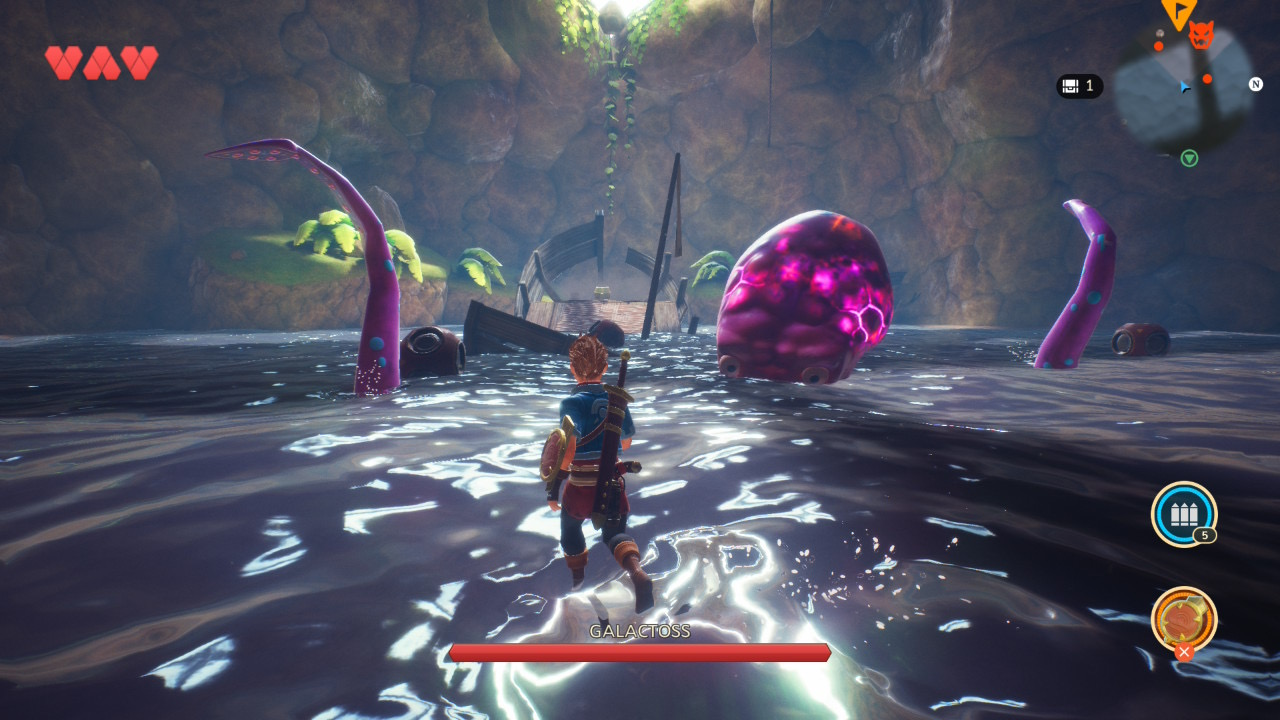
There is no arguing that this is going straight after the dungeon-based Zelda market. The metagame flow is to get to a new location, gain access to a relevant dungeon in the area, and defeat a big boss. Along the way you generally get an item or upgrade relevant to traversal there – bombs to get through blocked areas, swords for more damage, hookshot for covering gaps. The one big change is that you’re often accompanied by AI companions that also can get into combat or help with puzzles, though admittedly their presence is often not that useful beyond forced opportunities to use them.

The main place where the 3D transition really shows an inability to scale is simply in scope. This game only has three core dungeons plus a bit of smaller side content and mini dungeons that you hit along the way. There’s simply not much there to play and if you really put your head down this isn’t much more than 10 hours. That can be padded out via collecting side stuff, but it all largely comes down to treasure chests with items that convert to gold and there’s not a very compelling reason to even have gold. You can buy ammunition from vending machines, but the bulk heavy costs are for small upgrades to existing items that really didn’t feel like they affected balance much.
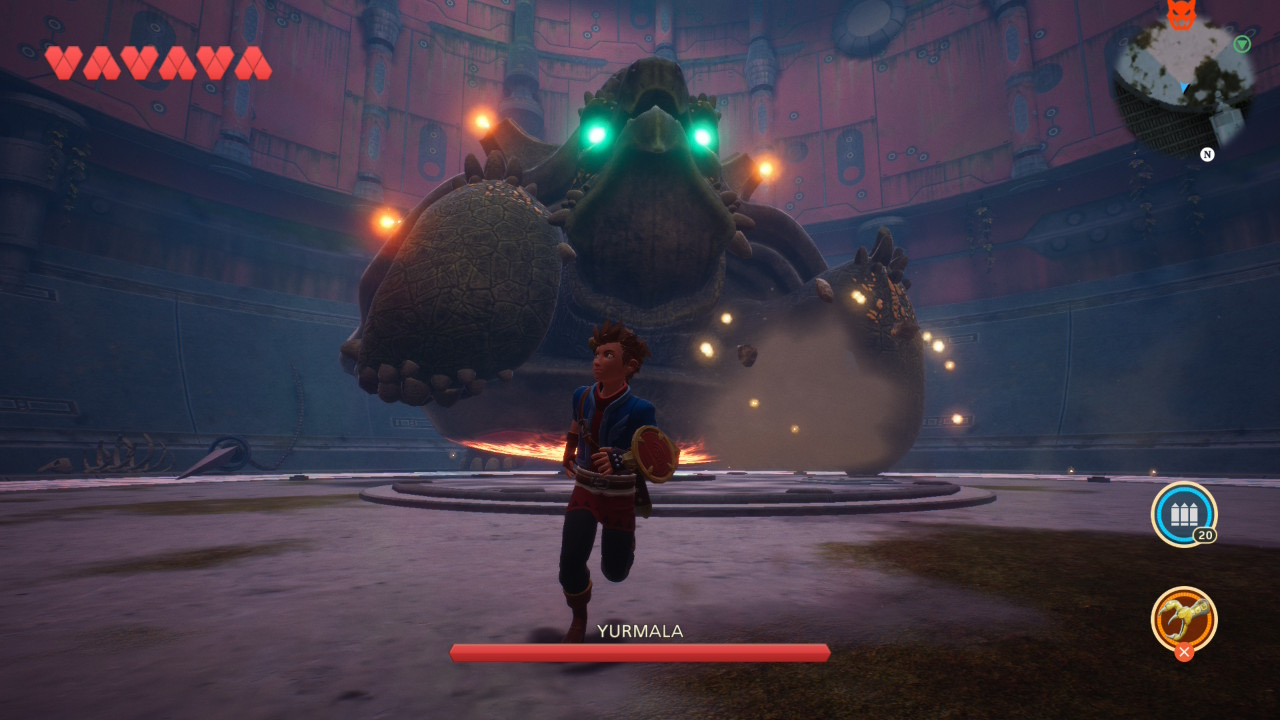
So then we look at core gameplay. On the surface it’s pretty solid. Core sword swinging is fine and works pretty seamlessly. Enemies have good tells for when they’re attacking so the player can dodge away effectively. There’s a gun system that’s the equivalent of Zelda bow & arrows, including elemental bullets, that is well used both in core combat (ex: freeze enemies) or in traversal (ex: solid patch of ice to walk on in water). The AI companions attacking also means that there’s quite a few situations in which the player is mobbed in a way that feels fun, even if the AI companies and NPCs distracting each other means the player situation is similar from a gameplay perspective.

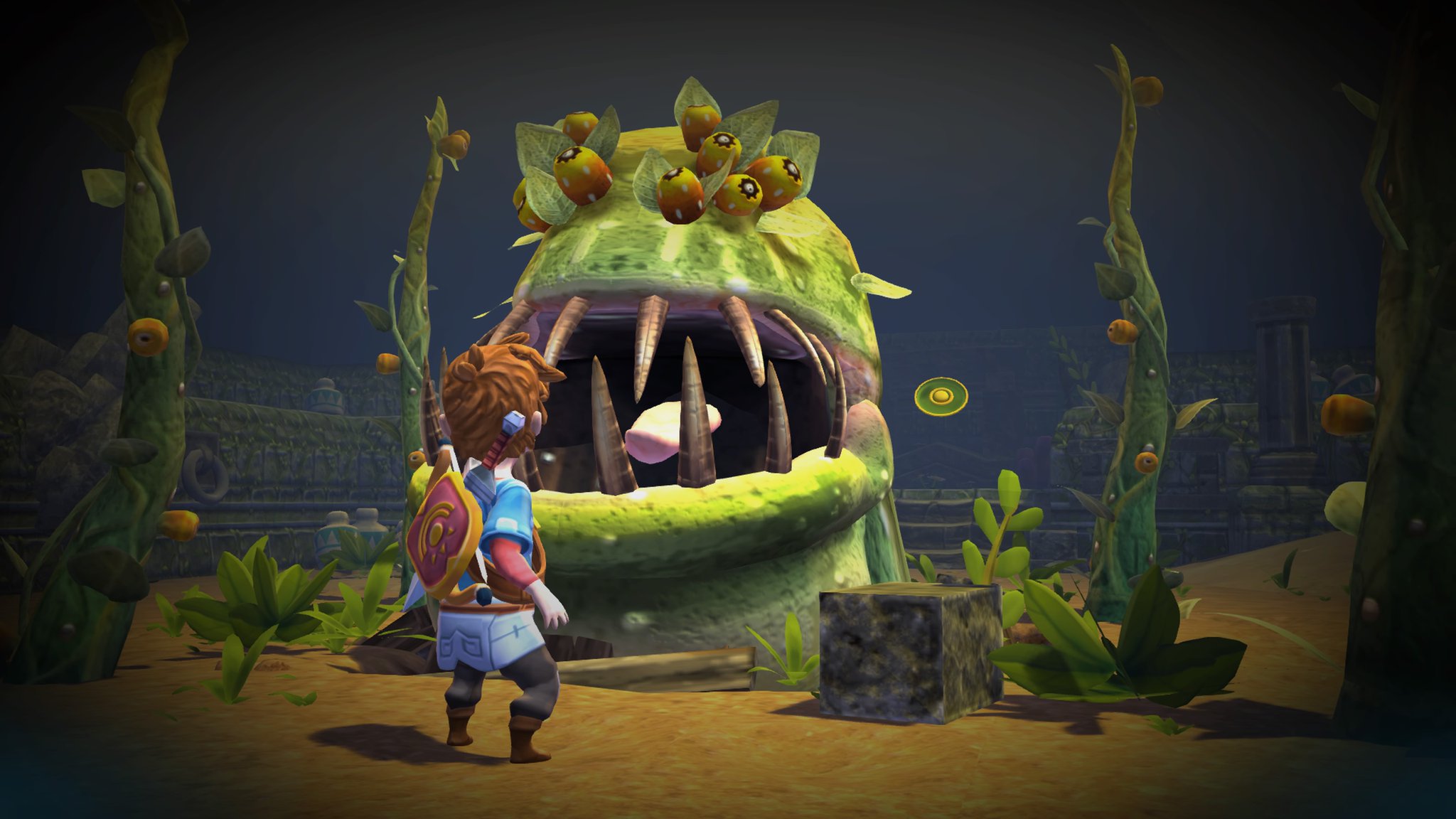
However, there’s a level of polish missing that is evident here that I think also ties back to this being 3D. The boss fights had kind of a pattern of exploiting a weakness then hitting weak points when the boss was dazed. In the example above, the player would use electric element bullets to hit a hook on the turtle and stun it, leaving open weak points on the legs and stomach. However, the pattern here was that you had to use bullets, which run out, which then resulted in me spending more time running in circles collecting more ammo instead of doing anything interesting. This was sort of fixed in the end game where the boss fight ended up just having a vending machine to use mid-fight instead of wasting time. It felt like a system leaning too heavily on limited resources with long grinding actions. This is accompanied by general lack of polish in camera use – for example, there’s no Z-lock – or movement where I was too often getting stuck on small collisions during combat.
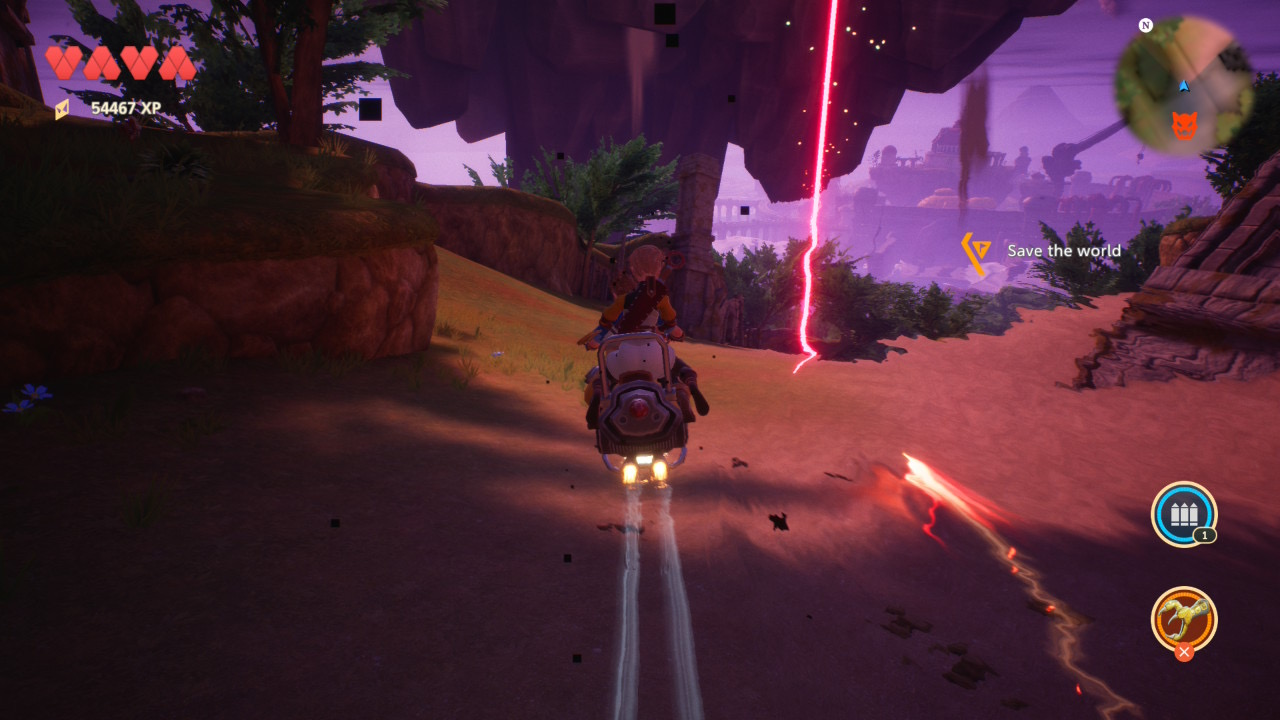
That’s not to say I didn’t have fun though. The boss fights are legitimately cool. The overworld and story is legitimately solid. The companion system and elemental gun are both really good. Visually it even handles itself well on the Switch, with the bigger brother console and PC versions looking spectacular. It’s just not quite there, needing another iteration or polish pass in its current iteration. However, it does make me want to take a peek at Oceanhorn 3 now that it’s out on Apple Arcade and I suppose if nothing else, that’s a win for a franchise.
Game Ramblings #61 – Oceanhorn: Monster of Uncharted Seas

More Info from Cornfox & Bros.

  • Genre: Action/Adventure
  • Platform: PS4 (previously on iOS)
  • Also Available On: Windows, macOS, Xbox One, Vita, Switch, iOS, Android

TL;DR

  • Decent take on a mashup of ideas from Zelda entries A Link to the Past and Wind Waker
  • Much improved experience playing the console version
  • Biggest weakness is in simplicity of the puzzles, though a end/post-game island shows promise in a sequel

The biggest surprise to me in playing this is how much the actual flow of the game had improved over the original iOS release.  I’d played it a few years back using one of those clamshell controllers for my phone, and while the game showed a lot of promise, it was extraordinarily easy to kind of lose track of what you were actually supposed to be doing.  Patches since that initial release, as well as the release on other platforms have brought a much better game, complete with additional cutscenes, voice acting, and some new items to help things out.  While it’s still a bit weak in the puzzle solving department, this ended up being a pretty solid take on the classic top-down style Zelda game.

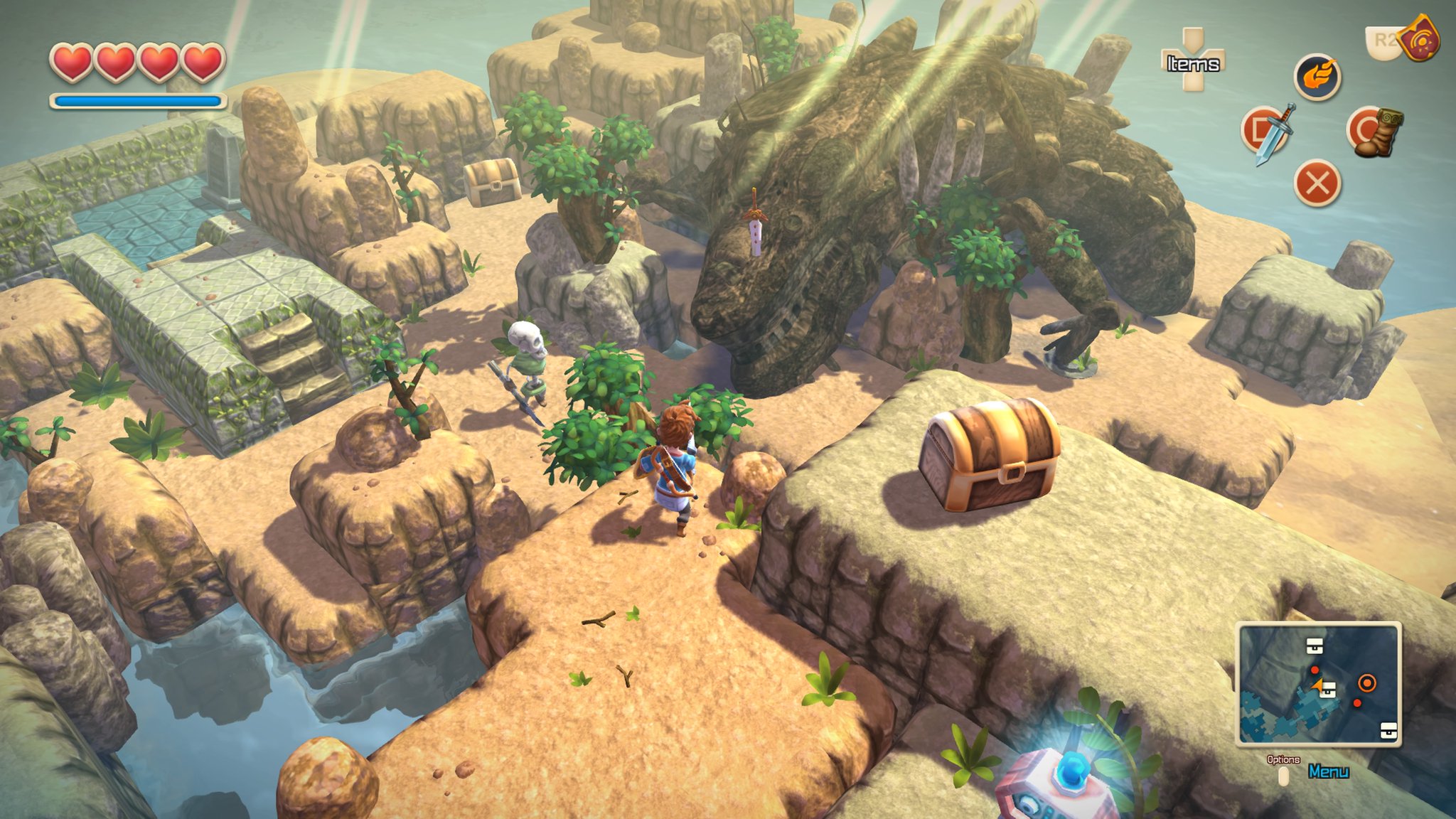
While the camera is spun 45 degrees, there’s no mistaking the viewpoint straight out of the top-down Zelda games.

Let’s get this out of the way; yes this is a direct take on the Zelda series.  You go around to a series of dungeons, use a sword and shield as primary weapons, a handful of items as secondary helpers (including bombs, a bow, and a few helper magic spells), puzzle solve your way to a master key, fight a boss, and repeat.  It takes place in a world where you have to sail around to small islands after a large apocalyptic event killed nearly everyone (hello Wind Waker!), where you ultimately set forth the events that should help rejuvenate the world.  It’s a direct take, but it does a solid job of taking it on.

One of the big positive changes is that due to the inclusion of analog movement, you aren’t restricted to swings from a specific direction like the typical 2D Zelda games.  This allows for a lot better fine-tuned control over attacking enemy weak points.  The sword swings also have a small combo chain, rather than a single fixed swing and stab, giving a lot more potential in fighting in a more nuanced way.  This is backed by some nice changes to secondary weapons.  The bow and arrow is pretty solid on its own, with a bit of shot magnetizing to make things a bit more feasible at range.  However, the inclusion of being able to shoot through flames to make fire arrows is a nice touch.  On the bomb front, they basically work like Zelda items in the environment, but when thrown at enemies they explode on contact, giving a lot more direct way to use them offensively, and not depending on timing as much.

There’s a boss in every dungeon, each with its own set of mechanics to deal with.

However, that mechanic change can be exploited, particularly on bosses.  The bosses in the game all have their own mechanics to learn.  The one above for example has tentacles that have to be killed out before the weak point is exposed.  In another, the player has to use a reflective shield to deflect a laser into the boss’ weak points.  However, by the time I got into about the middle of the game, bombs were my weapon of choice at a boss.  They have AoE damage to hit multiple targets, which is nice for taking out spawned adds.  They also do significant damage on their own at range, so I didn’t generally have to get into a dangerous spot to throw them.  Overall it made the difficulty of the bosses go way down, where I’d have preferred to see a little more use of clever mechanics to make specific items the preference, similar to Zelda series bosses.

There were other areas where I also saw this sort of not quite to Zelda level experience.  The dungeons have the typical puzzle solving, but by and large they consisted of simple box maneuvering or one-time use of items (shoot a target, drop a box on a switch, etc), rather than more involved experiences.  In general it made the actual puzzle solving pretty simple, which was a bit of a disappointment.

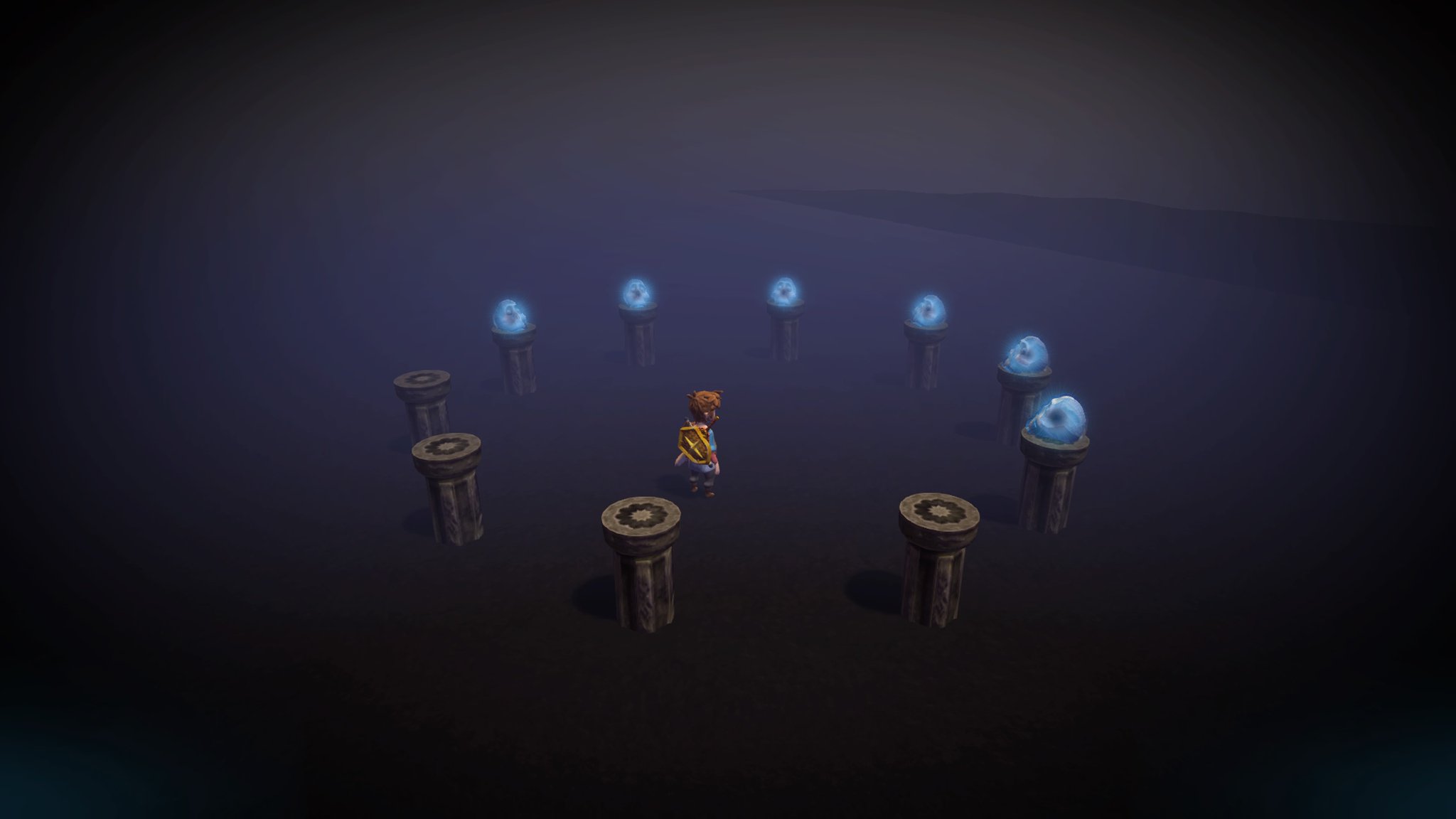
The Island of Whispers is the best puzzle-solving in the game, involving the collection of 10 cursed skulls.

The Island of Whispers is the one exception to the easy puzzles in place.  This island came out in the 2.0 release of the phone SKU, and has been in the subsequent PC and console releases, and involves the collection of 10 cursed skulls across an entire island.  Due to this, the entire island becomes the puzzle area, instead of a cramped dungeon.  Some skulls are simply there to find if you’re paying attention.  However, some require specific use of certain items, or chained use of multiple items.  Some require manipulation of the environment in order to gain access to new areas.  Basically, this one island shows a lot of potential for the sequel’s ability to grow in interesting directions, as well as the potential of the growth of team in tackling the ARPG genre.

So is this going to stand up against the Zelda series? No, not really.  While it is solid, there are some core things that bring it down a few notches.  However, I would say it’s worth the $15 asking price to play it.  It’s an entertaining experience with at the very least solid mechanics, has about 10 hours of content to run through, and at least brings this style of game to some platforms that are often missing out on Zelda.  While it’s not quite up to the level of the upper echelon, continued improvement by the team could bring us something really interesting when Oceanhorn 2 comes out some time here in the future.

So I also want to have a bit of an aside here on a particular fish (and ignore my PS4 typing skills), because I’m a sucker for fishing in videogames.  The fishing system in place here is one that is inherently RNG-focused, with an emphasis on player endurance to catch the fish.  The fish will somewhat randomly move left or right, with the player pulling against it.  After a period of pulling in the correct direction, the fish strength meter will go down.  If you pull in the wrong direction, or the fish is dancing back and forth, the meter goes up.  In general, this means that the way to catch a fish is to ride out the points where you can’t make gains (and usually have losses), while holding out for the moments of rest where you can chip away at the fish.

Generally speaking this is a fun way to make use of an inherently RNG-based system.  Skill can’t entirely stop the fish from fighting back, but it can stop things from running away from the player entirely.  However, this all falls apart when the fish adds in an offensive mechanic that kills the player.  Now instead of enduring for the big moments of gains, you’re rolling the dice that those moments of big gains will actually happen in time for the fish to get caught.  It’s a weird change in mechanic that eliminates the skill factor and turns the entire system into an RNG mechanic.  This is made worse by the fact that missing the fish LITERALLY MEANS YOU DIE, so you have to backtrack to the last checkpoint, heal up, do whatever is involved with that to get back to whole, and try again.  It was a weird change that I only happened upon because I enjoy fishing.