Game Ramblings #216 – Hyrule Warriors: Age of Imprisonment

More Info from Nintendo

  • Genre: ARPG/Musou
  • Platform: Switch 2

This was a wildly fun experience, but as I played it I was left with a particular thought – this is not a particularly good musou game. In isolation, this is a much better combat experience than your typical Warriors game but so much of it occurs in either 1-on-1 boss fights or small scale combat encounters, which is completely the opposite of what I expect out of the genre. So if it steers away from the core gameplay loop that much, is it still worthwhile?

When I think of your typical Warriors title I think about huge multi-person battleground combat maps where I’m trying to capture and keep hold of multiple camps while fighting off enemy commanders, leading to fights where I’m easily eclipsing 1000+ KOs in a single round. The first Hyrule Warriors certainly leaned into that for the most part. However, that screenshot above is more typical of your Imprisonment battle with large ones reserved for a few very particular story missions. Generally speaking, the bulk of content here is a 5 minutes or less game loop where you finish a couple quick objectives on the way to a solitary boss fight. Perhaps it’s because I didn’t play much of Age of Calamity but it caught me off guard.

If the musou experience is what you’re looking for, you just aren’t going to get it here. Even in the large fights it feels mostly lost. Sure, I capture camps but very few of them are ever in future danger of being recaptured by enemies. Sure, some secondary commanders spawn but they generally bee line right for one of my NPC commanders. Sure I have a party of people that I can command, but they are wholly incapable of taking out enemies or capturing points on their own, leading to a lot of swapping who is active as the player. If someone were to hop to this right from Dynasty they would probably be very confused as to why it’s carrying the Warriors name.
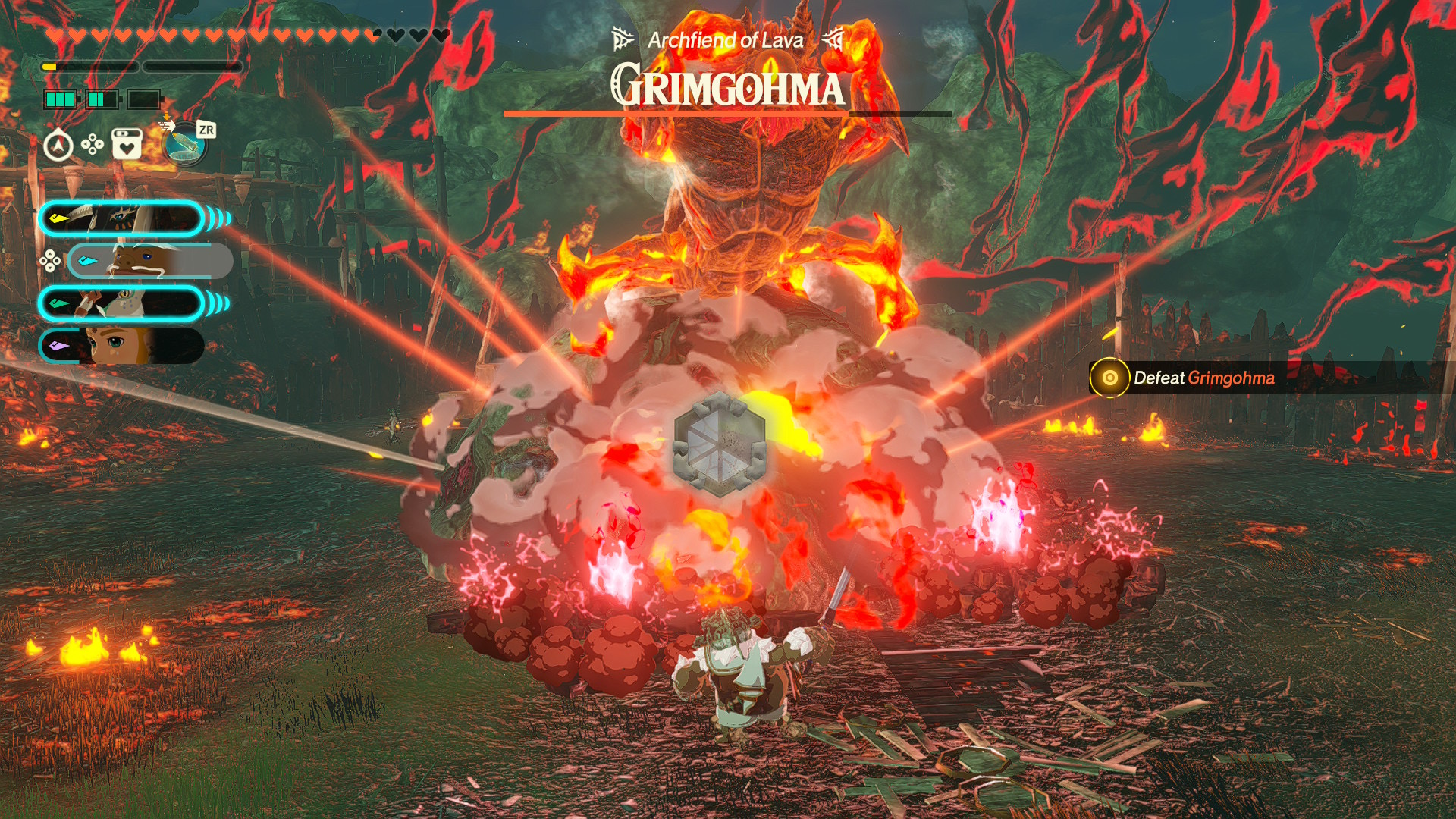
But then you play some more and the combat against bosses in particular starts to grab you. Boss fights are quite simply not just hack and slash encounters.

There are elemental attacks to take into account and chaining that you can do. For example, you can freeze an enemy with a series of ice attacks, then hit it with lightning for explosion. You can combine wind attacks with other elements to create tornadoes capable of hitting large groups. you can burn an enemy then hit it with water or ice to open it up for critical damage. Dodging takes on a ton of importance here relative to other Warriors games as well. Executing a perfectly timed dodge opens up the enemy for a flurry attack where the player can lay in a bunch of large damage, as well as knock down its stun meter. Once that stun meter is knocked down all the way, it also opens up the boss for a large attack generally capable of cutting down a quarter or more of its health at once. This is then combined with the ability for pairs of player characters doing combo attacks together for similarly large damage.

These one-on-one encounters then feel a lot less like a musou experience and more like a traditional action combat game, and that is greatly to its benefit. Where I enjoyed the original Hyrule Warriors for being a musou game, I started to enjoy this game because it was not. What it ends up being for me is a game that feels like a Hyrule experience shrouded in war, rather than the more individual experience that Zelda games typically have. It feels like it’s leaning on the action combat of the series, but not leaving away the fact that in war things are often going to be faster and more chaotic. The game loop then generally being short 5 minute segments ending in a boss makes a ton of sense. You are being encouraged to quickly dispatch with unimportant KOs and focus on the small handful of big bads that are really tuned to be fun to fight within the combat paradigm that they built for the game.

So that gets us back to the question – if it steers away from the core gameplay loop that much, is it still worthwhile? I think the answer that I arrived at is that yes it is still worthwhile, and it took the game continuing to beat me over the head with spectacle to get there. As the game went on I stopped thinking about whether or not I was playing a musou game and thinking more about timing my dodges correctly. It was less important that I was KOing 1000 things and more important that I was KOing the one boss. It was less important that I was doing hack and slash chaos and more important that I was chaining elemental attacks. The combat fundamentals end up being so much fun that the things that I initially felt were missing ended up fading into the background. Yes, this may not be a typical musou game, but in the process they’ve crafted something else that is a lot of fun on its own.

Game Ramblings #133 – Persona 5 Strikers

More Info from Atlus

Persona 5 Ramblings

  • Genre: ARPG / Musou
  • Platform: PS4
  • Also Available On: Switch, Steam

It’s always been fascinating to me how Omega Force has taken their Warriors gameplay and warped it into other series. Hyrule Warriors did a surprising job of integrating the Zelda items into the chaotic gameplay. Fire Emblem Warriors made great use of the weapon triangle to give advantages in combat. Dragon Quest Heroes and One Piece Warriors feel right at home within the source material of their series. However, Persona 5 Strikers may be the damndest of them all. It’s not just a musou conversion of P5. It straight up has the metagame feel of the JRPG, while still taking place within large scale musou fights. It’s an uncanny conversion that has resulted in a special sequel to what was already a pretty special source game, even if I had some complaints about boss balance in that one. Luckily, some choices were made to really smooth out the experience here, resulting in what is possibly an even better experience as a result.

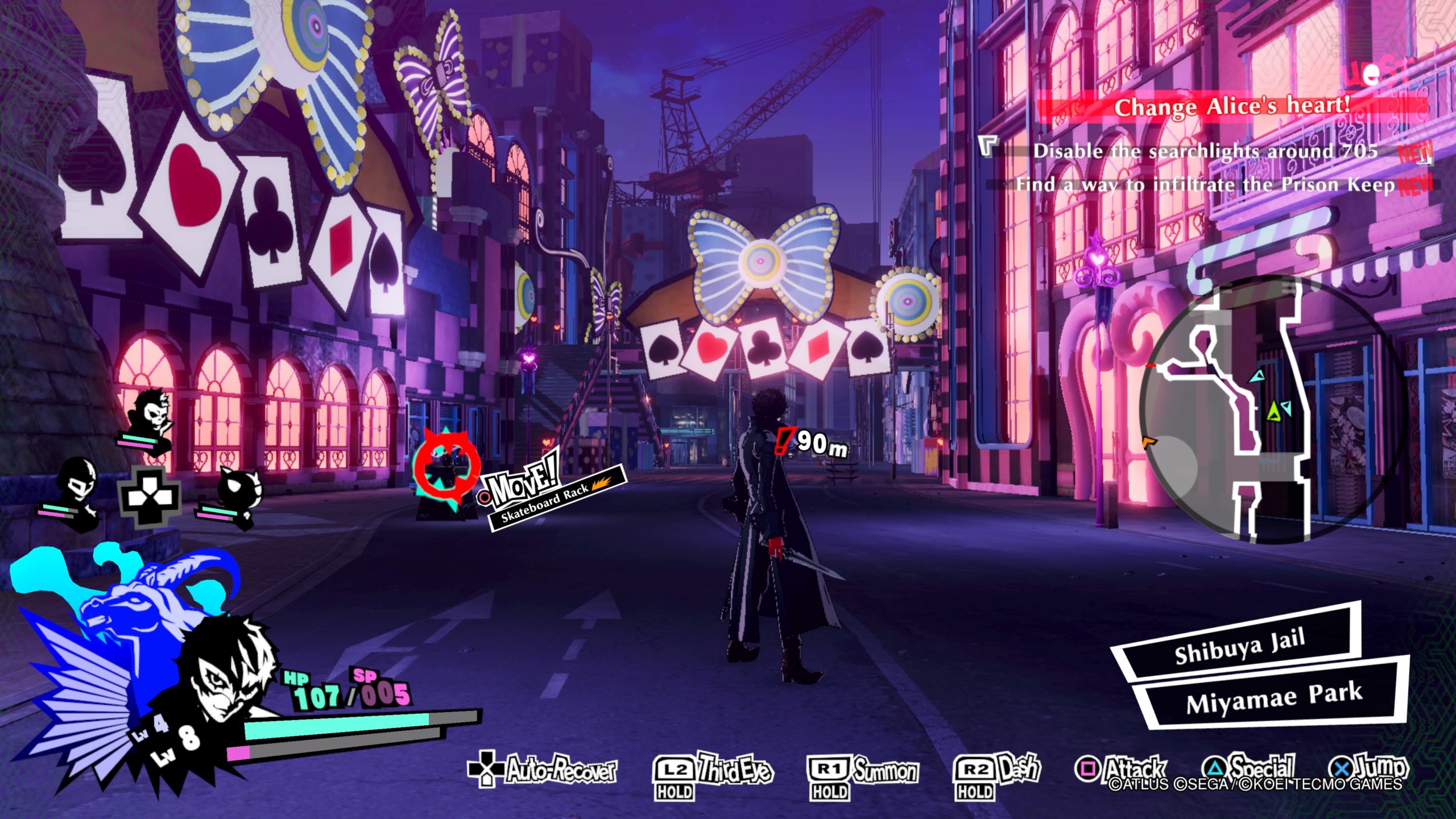
There’s a certain rhythm to a JRPG experience that just doesn’t jive with what I typically think of with the Warriors gameplay. Those are large battles where you’re running around taking over smaller zones on a larger battlefield. That also wouldn’t jive with the Persona series expectations. Luckily the team seems to have recognized that. Up until you’re actually in a fight, this feels like Persona. The terminology may have changed a bit, but this game’s palaces – now called jails – have the same setup that we already saw. You spend some time exploring the jail, hit some key locations to move the plot of it along, get to the point where you send out a calling card, and then fight the boss of the jail. It’s instantly familiar and easy to fall into, right up until you actually start a fight.

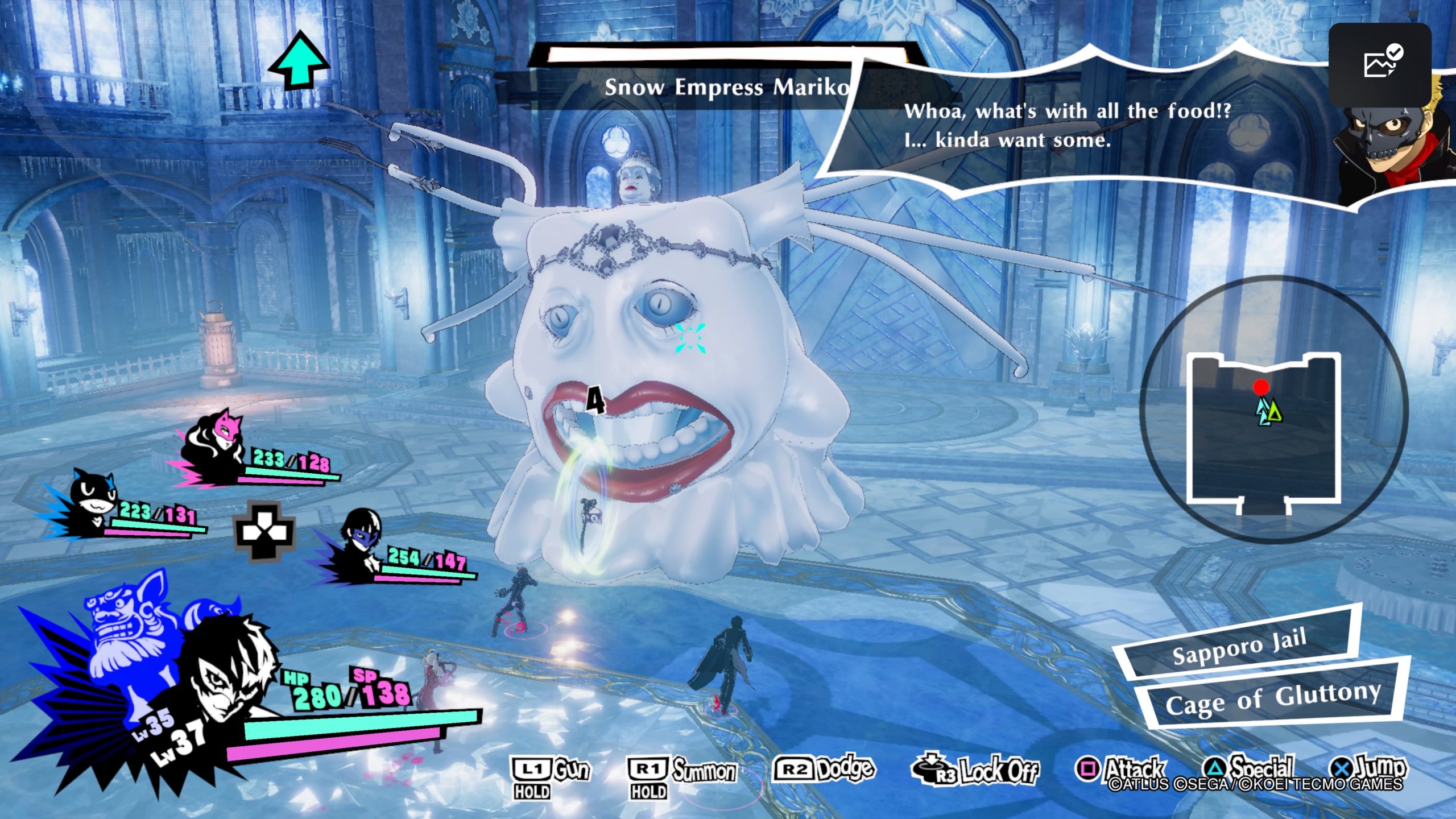
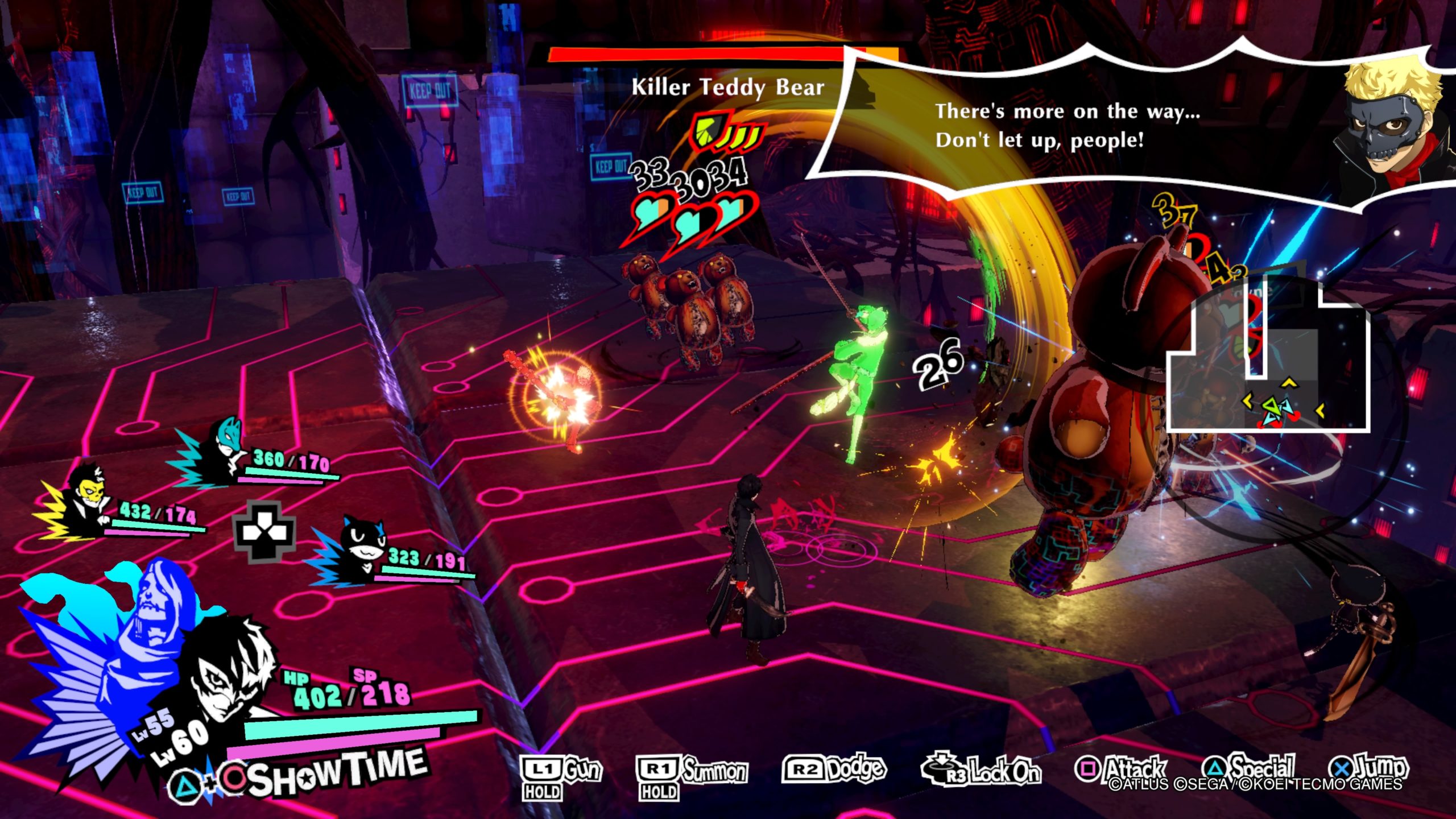
Combat is where the musou influences come into play, and boy is it as fun as ever to be in large scale fights. Trash fights will be anywhere from a handful to dozens of enemies, typically scaling based on how difficult the things you’re fighting are. However, even here it feels familiar. Personas still come hugely into play, as the elemental weaknesses from the previous game are still present. All-Out attacks are there, but they’re instead triggered via stunning enemies with attacks of types matching their weaknesses. Showtimes have returned from 5 Royal, but are now based on charging them up via damage and kills. Gearing and items are also both there in a very JRPG fashion. Basically, all the pieces are there, but now taking place against a ton of enemies in real time.

The real thing that surprised me is how all of those mechanics mesh well within the context of the new combat. The combat is fast and frenetic, but not overwhelming. I spent a lot of time dodging around as a default instinct, helped along by really good enemy targeters giving you a clear indication of when you should be dodging attacks instead of focusing on damage. Magic attacks with your Personas pause the combat, giving you a bit of time to strategize around hitting enemy weaknesses. All-out attacks do a short pause and ping the enemy that can be hit with it, giving you a clear indication that you should be shifting focus. It’s all fast and fluid, but very clear in terms of what’s going on. For a musou title, that’s actually kind of surprising, since they can often be large periods of mindless spam, where the strategy is at a metagame level instead of the actual combat.

It’s also kind of surprising how well this scales down to battles of one. Boss fights are largely one vs the party, and it just kind of works. The bosses have bigger mechanical pieces and a much larger chance to nuke the party if you aren’t paying attention, but it feels fair. Boss nuke mechanics can be interrupted by hitting their weakness, which encourages a pretty diverse Persona squad. However, the boss locations also typically have environmental pieces that can attack those weaknesses as well. I had problems with Persona 5’s bosses, where it often felt like a pattern of die once, figure out the weakness, then easily win. Here, the bosses uniformly felt tough but fair. Going into a fight without the right Persona made the fights significantly harder, but I could still win. Going into a fight without SP generating items meant that I would want to preserve SP for healing, but I could still win. As long as I was committed to dodging mechanics I would get through it based on skill, and not need to cheese the fights.

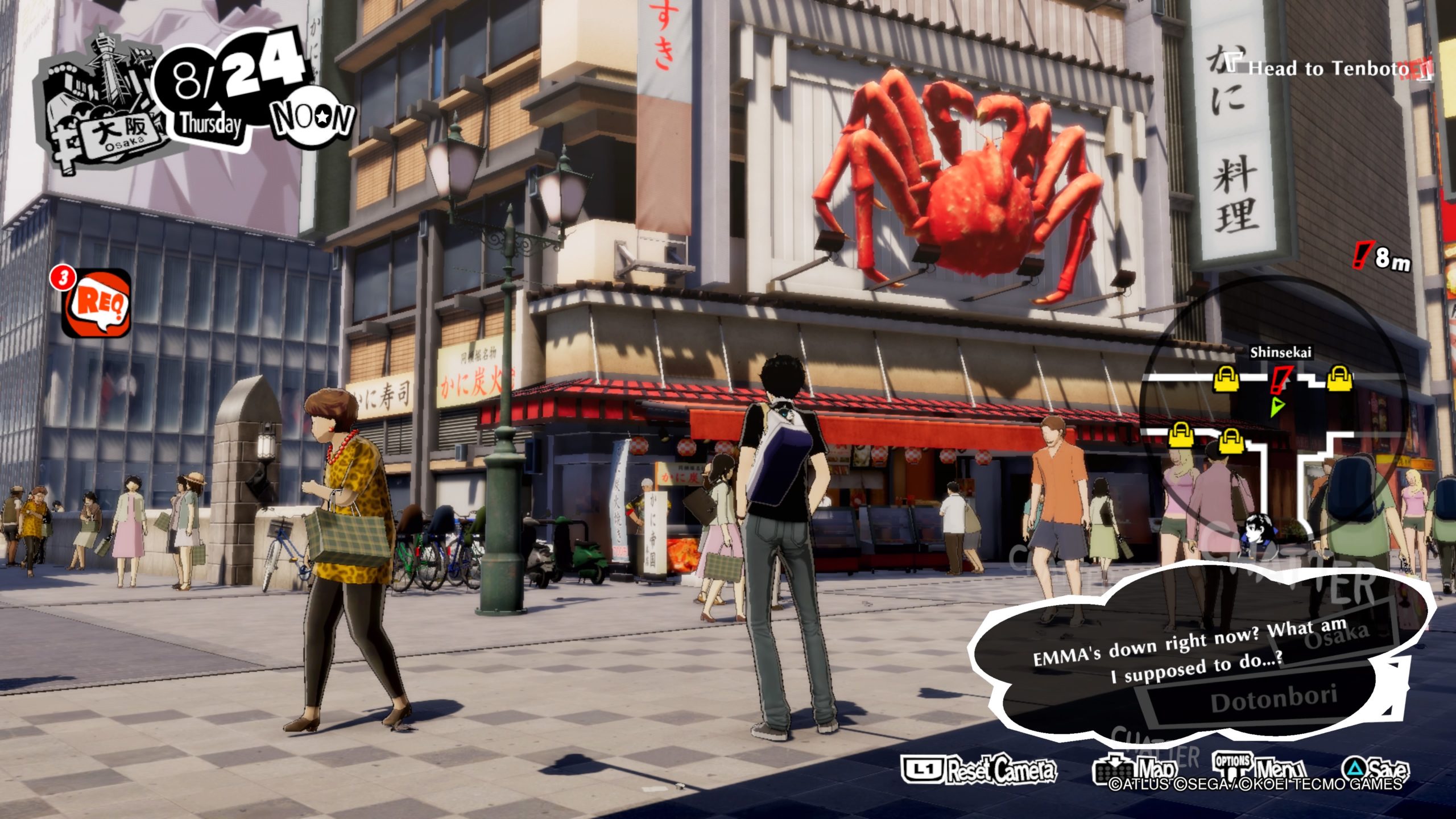
This is also kind of a hot take but they got rid of the time limiting calendar mechanic and I couldn’t be happier. I get that limiting your activities and forcing you to focus on some subset of things is kind of a Persona standard at this point, but I’ve never been a fan of it. In general I don’t like time gating mechanics, as it feels like an unnecessary forced stress point on players. P5S only has the calendar for story purposes. You can jump in and out of dungeons as much as you want and the calendar won’t move forward. It feels like a best of both worlds. The calendar is there to act as a framing device for the plot, but it’s no longer there to be a limiter on the player.

I’m hoping to see something like this done for future mainline titles, even if it just means that you get a little more freedom to do multiple things within a phase of a day in a future P6. Want to talk to multiple people in an afternoon because they all go to your school and why the hell couldn’t you do that? Yes please. Taking a Persona 5 example, want to do make some progress in a palace then switch over to Mementos because the palace is too high leveled for your current party? Sure why the hell not? Don’t waste an entire day because you were going into the unknown. It feels like there’s options for them to make the calendar less punishing without losing the heart of the series, and I hope that the mechanic being entirely gone in a spinoff allows them the ability to rethink what they want with the mechanic.

This is both a sequel and a spinoff, and it works well in both cases. As a sequel to Persona 5, we get a fun story that makes sense in-world and gives more time with a set of characters that I really enjoy watching. As a spinoff it gives an entirely different type of gameplay, while still feeling familiar in its inclusion of specific mechanics from the previous title. As a Warriors game, it also shows some of the largest range in terms of pulling two series together. It’s just a fantastically well made experience that I can’t recommend enough.