Game Ramblings #127 – Immortals: Fenyx Rising

More Info from Ubisoft

  • Genre: Action RPG
  • Platform: PS5
  • Also Available On: PS4, Xbox One, Xbox Series X, Stadia, Switch, PC

It’s pretty easy to look at this game and consider it a ripoff on Breath of the Wild, and frankly that isn’t necessarily the most wrong thing. It definitely shares a general metagame with BOTW, and it has the obvious gameplay hook of stamina while climbing. However, that’s taking an overly simple look at things. Immortals takes some steps in interesting directions that give it some unique legs – and quite frankly shows some good iteration on the general style beyond BOTW.
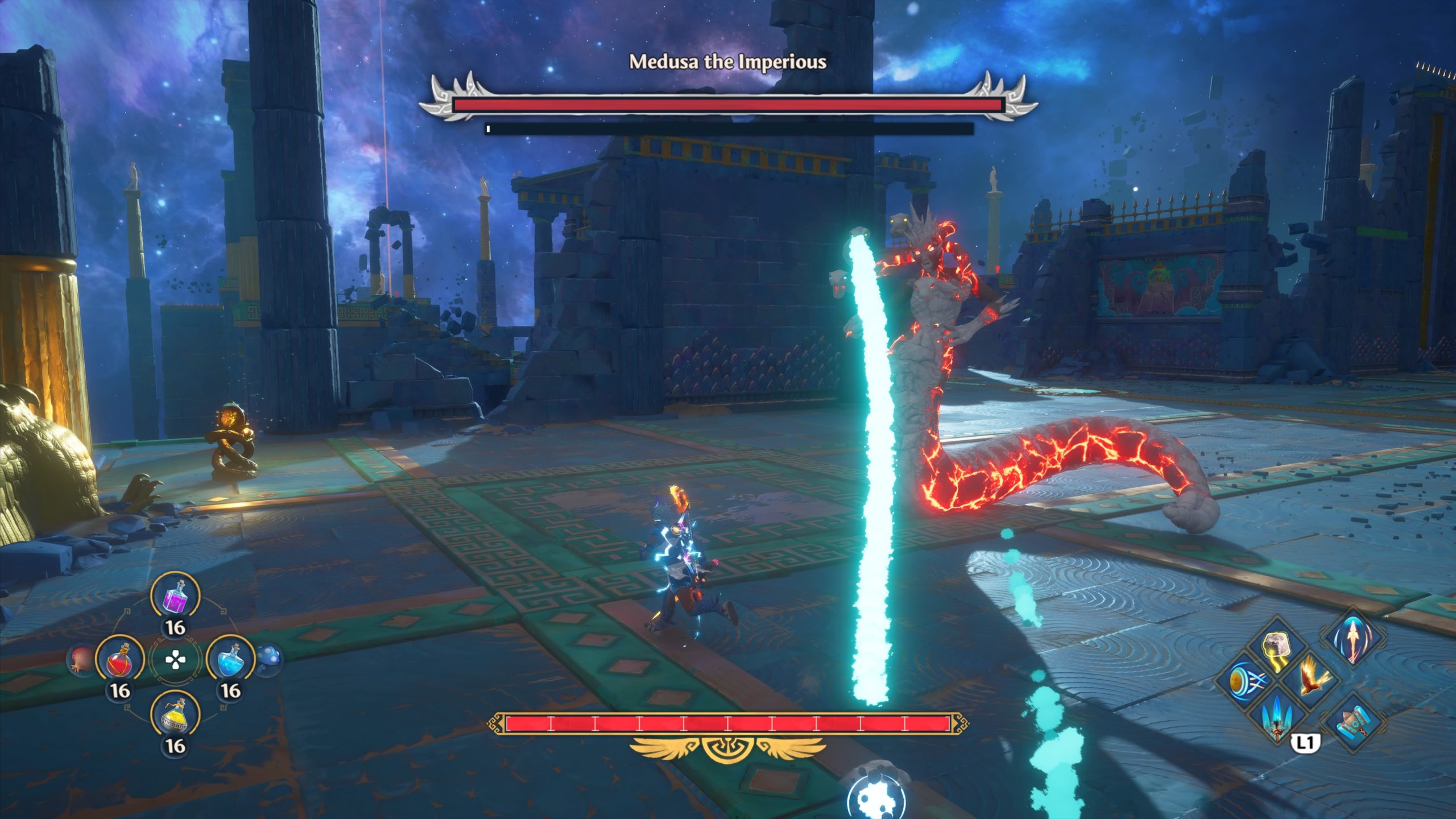
If there’s one way I’d really describe the overall metagame of Breath of the Wild it would be exploration supported by combat. Combat wasn’t the focus, and for the most part you could get through the game without fighting just about anything. The meat of that game was exploring to find shrines, and finishing the puzzles within. Immortals feels like a very different approach to me – combat supported by exploration. There’s definitely not a lack of puzzle dungeons, and the overall game flow is similar, but so much more of this game is based on combat, and that’s really the first bulk of differences from BOTW.

I suppose what’s important here is that their combat is really a lot of fun. There’s definitely a very Assassin’s Creed approach here, which isn’t that surprising. At its core you’ve got a similar approach of watching for enemy tells so you can parry or dodge attacks. There’s definite lessons learned here from their other series because the tells are extremely well done. Even with short timing, the enemy will have some obvious windup tick or some flash of particles or some full-body emissive effect to tell you that an attack is coming. For me it hit that nice line where the tells are fair, but still require good timing. Simply dodging or parrying is effective on its own, but nailing the timing gives you things like slow motion to get in some quick hits so there’s a certain level of benefit that makes being effective at these moves worthwhile.
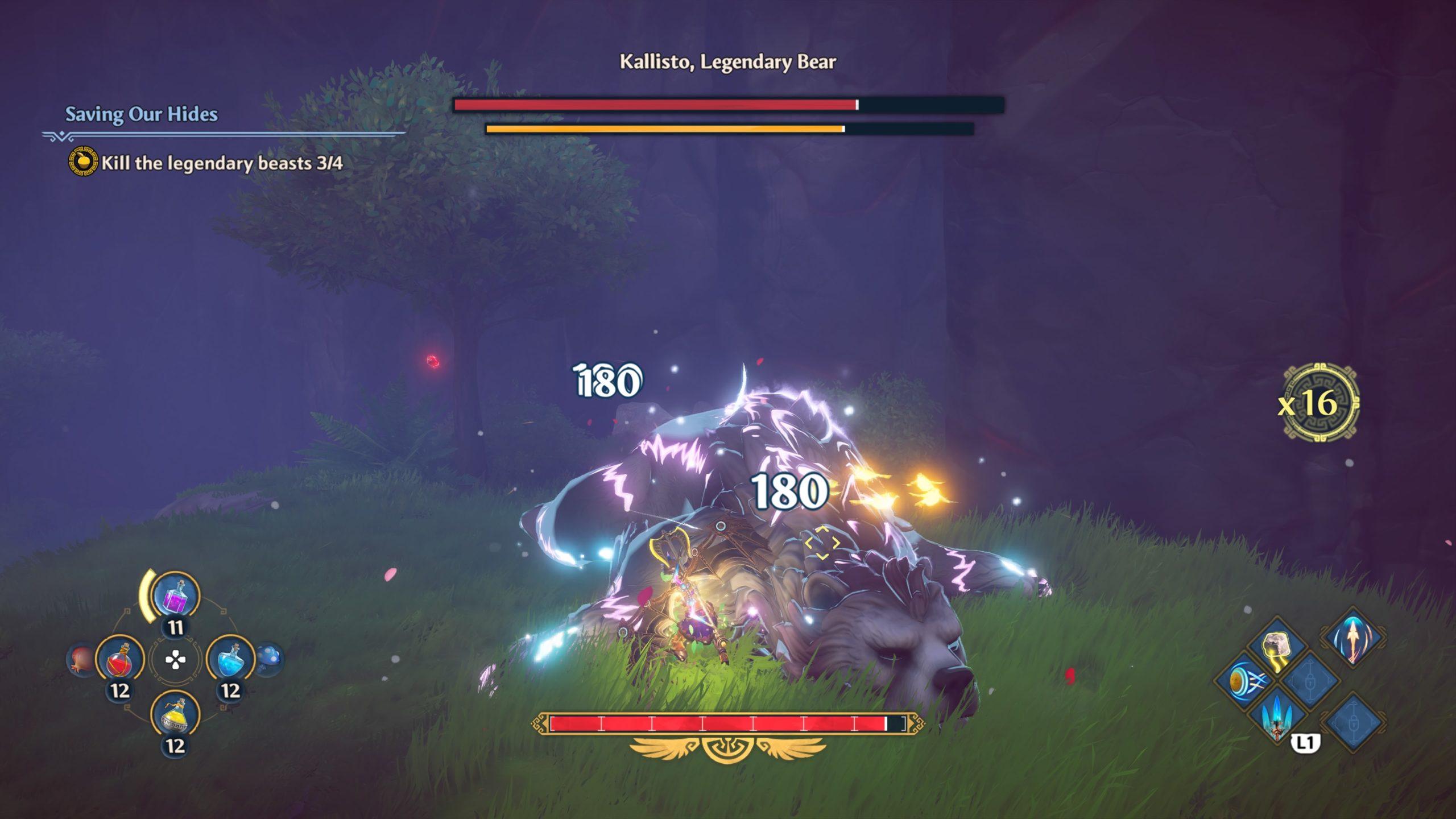
There’s a secondary layer to combat that really worked out well in the integration of a stun system. This feels pulled right out of Final Fantasy 15, but the short version is that damaging an enemy enough can cause it to go into a stun state, opening up the enemy for some real big damage. Where this is really well integrated is that your best use of stuns is a slower attack axe, where the real damage potential is in a fast attack sword. This hugely encouraged me to be switching between the two weapons a lot, which really prevented combat from becoming boring. This also provided some interesting potential for larger group fights. Stunning a few enemies would allow me to then shift my attention elsewhere, rather than being overwhelmed by a bunch of enemies. In both group and larger solo fights, the system is extremely effective in a way that feels completely unique to this title, and really provides a direction for how improved combat mechanics could improve BOTW2.

That’s not to say that the game is all combat all the time. There’s definitely a lot of cool puzzle shrines here, and in a lot of cases they’re similarly silly and physics based like BOTW. However, there’s a lot more traversal mechanics at play that really give another sort of +1 to this iteration of the overall gameplay. BOTW had a lot of incidental secondary ways to solve shrines through clever or weird use of mechanics. Immortals feels a lot more direct. It’s got things like vertical and forward dashes to really push traversal. It’s got a magnetic-style ability that can push and pull objects around to set off weight plates. And ya, BOTW had some of this stuff, but Immortals separates itself out by having everything more easily accessible.

Immortals has everything on hotkeys. L1 plus a face button will activate one of these abilities, so they’re always there. You don’t have to switch between abilities in a slowing menu, which is a huge benefit for general speed of use. The other benefit is that all of these abilities use the shared stamina pool, rather than individual cooldowns, so they’re available all the time and can be chained back to back. The net result of this change is that puzzles are often less about doing a sequence of steps one at a time, and more often executing a fast series of steps rapidly. It’s an interesting dynamic shift from some of the more logic-based puzzles of BOTW and instead really reinforces the heavy physics-based puzzles that were some of my favorites.
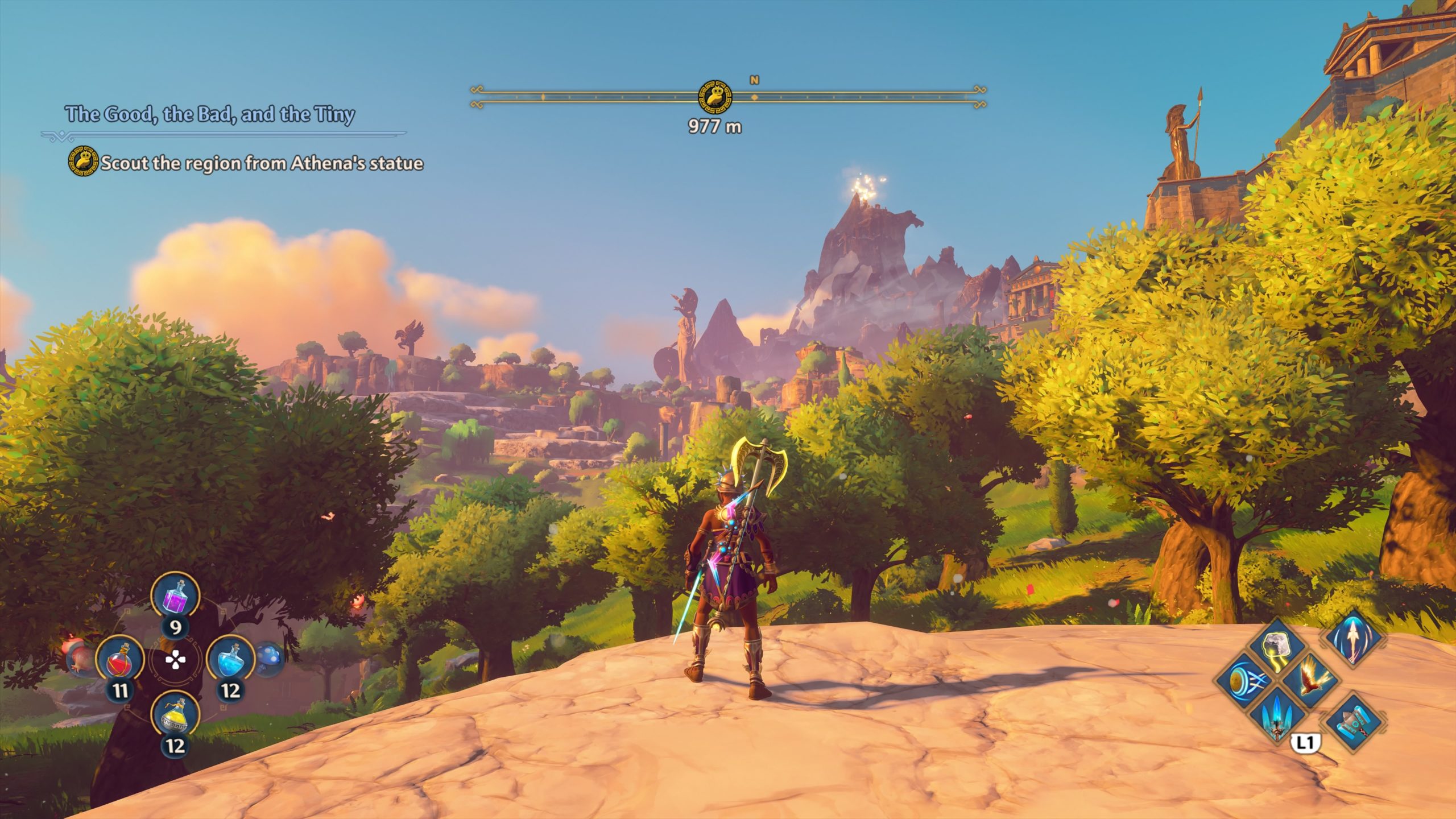
When I did my ramblings for Breath of the Wild, it was pretty clear how special that game was. Even with four years gone, that’s still apparent. However, I think Immortals is at this point the better game. It clearly took the metagame and general physics fun of BOTW, but added in a lot of iterations in combat and ability use. Having the combat iteration in place added so much variety to what you’re doing, which is never a bad thing. Instead of going from spot to spot looking for a shrine ping, I was now going from spot to spot sometimes doing puzzles, but just as often fighting epic bosses and creatures of legend. It’s those kinds of changes that really push games forward, and in doing so it’s pretty clearly shown that there’s a lot of room for iteration in the sort of exploration-based open world ARPG subgenre.

Game Ramblings #113 – The Outer Worlds

More Info from Obsidian Entertainment

  • Genre: FPS / ARPG
  • Platform: PS4
  • Also Available On: Xbox One, Windows, Switch

I’m not a huge fan of the recent Fallout games, so it may seem weird that I decided to play the spiritual followup to New Vegas. However, it was never the world or story I had a problem with. It was entirely the shooting mechanics. The Outer Worlds from the outside seemed like it was at least attempting to play more like a typical shooter that has RPG mechanics, rather than an RPG that uses guns. This definitely leans closer to a game I can enjoy, but it’s not without its mechanical issues that knock it down a few notches.

The first-person Fallout games never really made sense to play without using the VATS system. The straight shooting mechanics were pretty garbage, and leaned heavily on stats in ways not typical of FPS games, while the VATS system provided a much more accurate way of figuring out your chance of hitting things without having to deal with aiming. The Outer Worlds on the other hand is very distinctly an FPS with RPG wrapping. Shooting is much more of the core experience, with only a bit of an ability to slow down time for limited periods to help with aiming. In that regard, this is definitely a much smoother shooting experience.

However, that’s not to say that I found it to be a mechanically good FPS, especially with respect to playing it on console. At a base level the weapons generally feel kind of lifeless in a lot of respects, with pretty weak recoil and camera shake. As an example, the difference between high damage pistols and rifles or mid damage automatics is pretty irrelevant, so I tended to just go for highest single-shot damage and spam fire since I wasn’t going to deal with a typical single-shot high damage doom recoil.

On a gamepad, the feature set there was even more disappointing. They have the typical trappings of a gamepad shooter with some amount of aim acceleration, target adhesion, etc. However, it pretty uniformly felt like the activation range of gamepad aim assist features was significantly below the functional range of the weapons I was choosing, and also well closer to enemies than I wanted to play in the style I chose. The result of this was that it felt more like playing a pre-Halo console FPS, where I was just tapping the camera stick to get close enough to use strafing to finalize my aim and guarantee hits. Compared to the high-end of console FPS, it just felt like the features were a secondary thing that hadn’t been put through much testing.

This all kind of came to a head in the general player UX. It was more often than not that I didn’t really realize I was dying or nearly dead until it was too late. I’d be trying to effectively aim at things beyond the assist range while depending on my team to prevent flanking. They would occasionally get killed, allowing enemies to flank and kill me. The big issue throughout all of that is that it was never that obvious that either my team or myself were dead or dying. The UI elements for health are small and packed in the corner, so they’re out of focus. Damage indicators at least to me weren’t in your face, up until the point where I was at very low health, which typically was too late. The aiming issues combined with that were the leading cause of death for me, and it was generally a frustration point because it felt entirely preventable on both accounts.

That said, the rest of the game was generally of the style that I really wanted it to be.

The core progression of the game is a series of quests that take you around to small hub worlds. Each world has its own set of side quests to do, factions to help or hurt, and secrets to find. Blowing straight through the storyline would have been a quick affair, but there’s so much to miss just doing that. The side quest lines that you get involved in all have fun storylines to run through, with their own entertaining set of people to meet. In a lot of ways, this felt more similar to Mass Effect than to Fallout to me, where the main story would get me to a planet, but then I’d get lost in the local story for a while until I later got back on track. Generally speaking, if a game has me playing the side quests for the sake of them being fun rather than for needing the rewards, then I’m pretty happy with the end result.

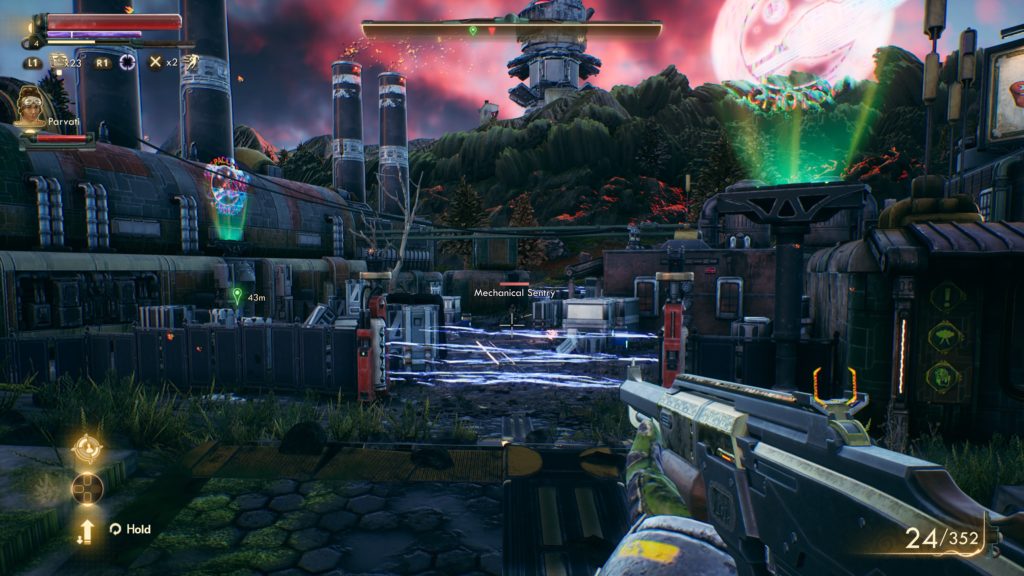
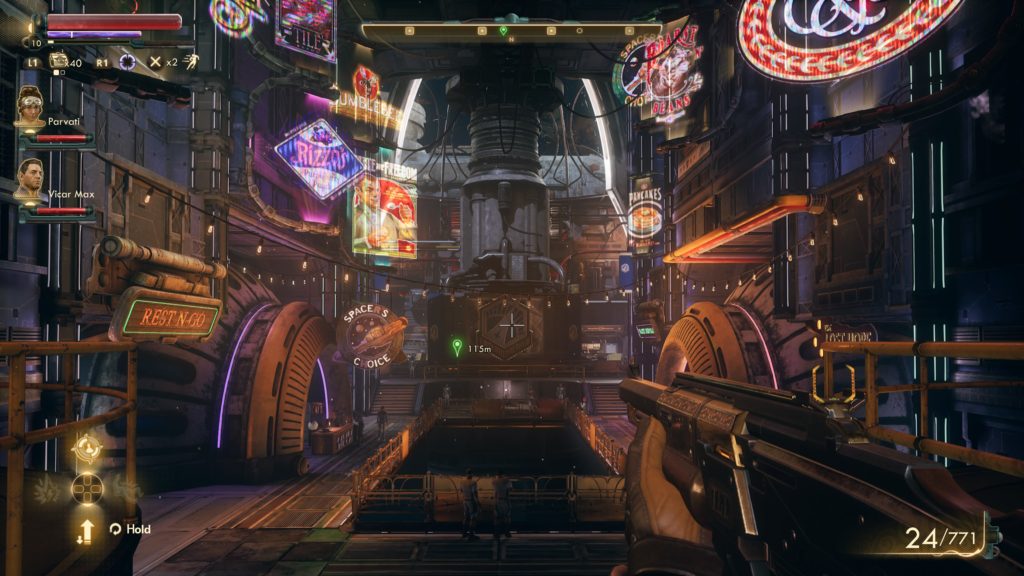
This is all helped by a visual style that is distinctly not Fallout. This is a supremely colorful game, which is both a blessing and a curse. You’ll never mistake this for a brown post-apocalypse setting. While this is a lot of fun to look at in isolation, it’s also exceedingly busy. While this isn’t usually a problem, I did lose enemies in the visuals from time to time, especially on the smaller end of things. That said, I much prefer visual brightness and loudness to the drab wasteland of the Fallout series, so I’ll take losing some silhouettes from time to time as the downside.

The rest of the RPG trappings are also a lot of fun. There’s a ton of variety to build out with regard to your stats and inventory. Of note for me was my ability to build out what ended up becoming basically a lockpick master. I leaned heavily into increasing stats in 3 main areas – long guns for offense, lockpicking for crates, and hacking for electronics. In doing so, I was able to break into almost anything that was locked. This allowed me to make up for my deficiency on the defensive side of things by having a much larger ammunition and weapon upgrade pool to choose from than I’d otherwise have typically had. It’s this kind of customization that brings me to play more western-style RPGs, where mechanically they’re often otherwise kind of slow and clunky. The customization on top of being more action-leaning did a lot to keep me playing this one until the end.

This one is curious, and definitely shows some growth for Obsidian now that they’re disconnected from the Fallout IP. Ya their shooting mechanics aren’t the best, but they’re distinctly a step in the right direction. The rest of what’s there feels like what made New Vegas work to begin with. Good writing, good RPG underpinnings, fun characters, and an entertaining world. With the budget of Microsoft behind them and some time bringing their FPS mechanics towards industry-leading this could be a special series.

Game Ramblings #111 – Trials of Mana (Remake)

More Info from Square-Enix

  • Genre: Action RPG
  • Platform: PS4
  • Also Available On: Switch (original in Collection of Mana and remake), Windows
  • Originally On: Super Famicom

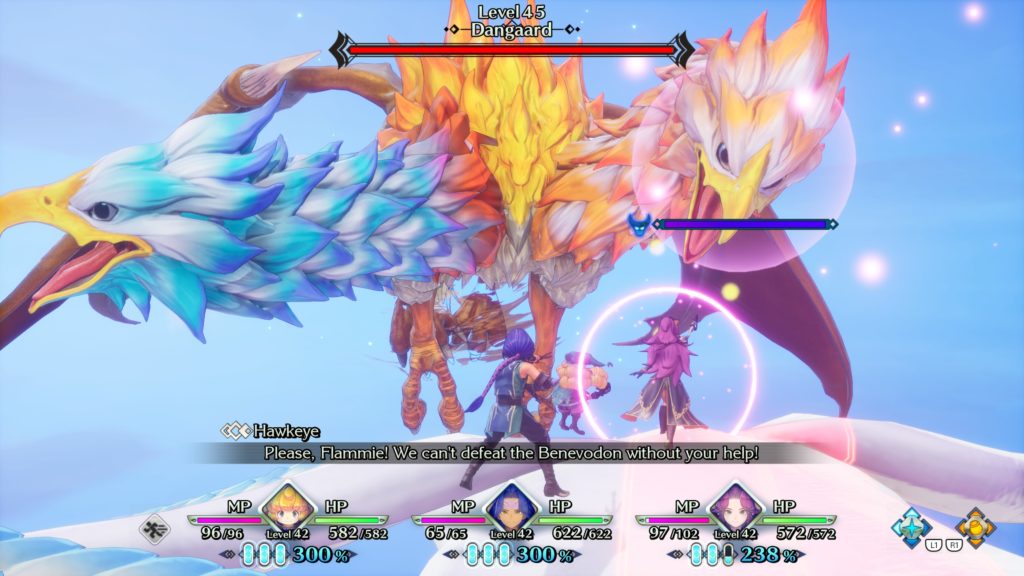
Where Final Fantasy VII Remake took a classic and completely reinvented it, this is more of a careful remake. Ya it does some things different than the original. Ya it’s in 3D. However, it follows a pretty safe path in modernizing the original instead of reinventing it. At the same time it’s a lot of fun on its own, so I didn’t particularly mind the areas where it still felt stuck in the 90s. If it wasn’t for AI difficulties, I would have no problem pushing this one more, but the AI really ran into problems that I’ll get into.

Where Secret of Mana’s remake felt odd because it stuck to its design, Trials feels good for the same reasons. Trials in general was always a more modern approach to the ARPG formula, having things like distinct combat areas, combo-based attacks instead of stamina, easy access to magic and skills, etc. It all worked pretty well on the SNES. In 3D it still works just as well thanks to some pretty solid implementation of hard lock targetting and target switching on the right analog stick. In its current form, it feels pretty reminiscent of the Tales of series, which caught me pretty off guard. The fights have a pretty good flow to them in normal trash fights, and for the most part the bosses played a balance that I really enjoy – not punishingly difficult, but longer in form and with multiple distinct phases, forcing you to keep focused and learn on the fly.

However, the boss fights are really where the AI struggles. As the game progresses, there’s more frequent segments where some high priority targets spawn with a timer. At the end of the timer is usually some punishing mechanic – maybe the boss gains 15% health back, maybe there’s large AoE damage, maybe there’s more adds, maybe it’s a guaranteed party wipe. By and large these are things that MUST be killed, and fast. However, the AI has extreme problems targeting them, and if you even get lucky, the AI typically won’t hit them more than once or twice before going on cooldown. Of the probably 6 or 7 times I party wiped in the game, I think only one of those was because of something other than a timed segment where the AI simply didn’t attack.

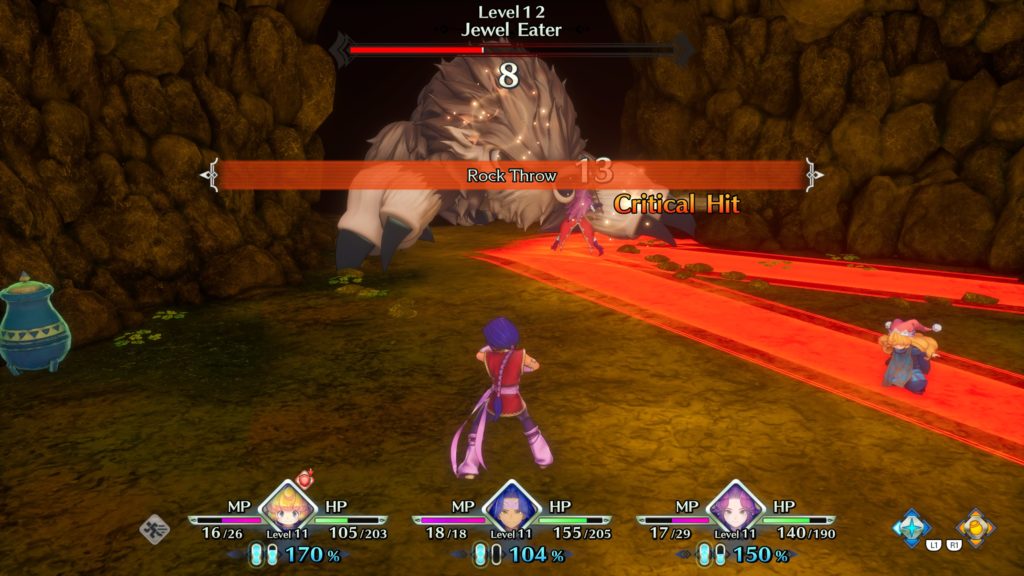
On the other hand, the game is extraordinarily clear about how the enemy is going to target you with special and magical attacks. Targeters are large and red, and very precise to the area that will be hit. They also fill in various ways to indicate when attacks will take place. Circle AoE fills from the center out. Sweep cones will go from the inside to outside of their sweep. What I like about all of this is that dodging attacks is never about small tells or dramatic animations. It’s 100% about paying attention to where you are, what the targeter is doing, and having an idea of how long you can stay in place attacking before dodging the hell out of the way. It’s both incredibly clear in execution, and allows for attacks to be incredibly punishing when they hit you, which ends up being a very fun and very fair combination.

The rest of the game kind of is what it is. The story is a straight pull from the 90s, and is a plot we’ve seen 1000 times before. It’s got a pretty cliche fantasy take on some other dimension dude taking over someone’s body and sending its minions in to sow chaos and take over the world. On the other hand, they’ve added a ton of voice acting across the board, so the story that is there is much more alive than in the past. Towns still feel like 90s JRPG standards. Ya there’s a bunch of people, but they nearly all throw irrelevant one liners in conversation. As a result, towns still work as the usual standard three stop affair – weapon shop, armor shop, inn to sleep and save. However, it’s still as fun as ever to walk into a town and buy out the entire upgrade stock, leaving the town as a more powerful badass version of your party. This release also has the same class tree as the original, which is effective but nothing new. Each branch of the tree has a bit of a specialization, and you can definitely tailor it to your preferred style, but it’s not doing anything that isn’t standard to the genre.

As safe as this release was though, it is still fun. Ya the AI problems on boss fights suck, but you get through them. Because the battle style focuses more on skill than numbers, I didn’t really need to putz around grinding. However, the game also gave out a fair amount of XP to balance that so it wasn’t like I was surviving purely on grit and determination. Trash fights have a really nice flow to them, so that never got boring. Ignoring the AI problems, the boss fights were also mechanically fun and long enough to feel like a real accomplishment. Is this as impressive a remake as Final Fantasy VII Remake? Absolutely not. However, it doesn’t feel like it was trying to be, and where it ended up feels like where it belonged.