Game Ramblings #45 – Yakuza 0

More Info from Sega

  • Genre: Action/Adventure
  • Platform: PS4

TL;DR

  • Excellent combat with multiple styles to fit different fights
  • Swapping between characters worked well due to how the story timeline worked between the two
  • Difference in tone between serious story missions and almost 100% non-serious side missions somehow didn’t cause issues

The Yakuza series has always been more of a Shenmue than a GTA, and Yakuza 0 doesn’t change any of that.  This one provides a new starting point for the series, providing some back story to the events before the original entry in the series.  It takes the same mix of combat, light puzzle solving, and high levels of drama, and modernizes it a bit as the first PS4 entry in the series, giving us another great entry to play.  Despite being played across two characters, the story manages to send enough clues cross-character to weave together a fun narrative, with plenty of action and violence expected of the genre.

The combat in place is similar to past games, taking place in small areas walled off by onlookers, where enemy groups of varying size can be attacked.  Combos of attacks can be grouped to knock down enemies, building up secondary resources to do more spectacular (and powerful) attacks.  From a high level it’s fairly simple, but different variations of button holds, character placement, environmental interactions, and most importantly, multiple fighting styles add a lot of depth.  Of note, the fighting styles all feel fairly different, and bring advantages to different fights.  Both characters have a fairly standard brawling style and legendary fighting style, but the real fun is in one of each character’s other styles.

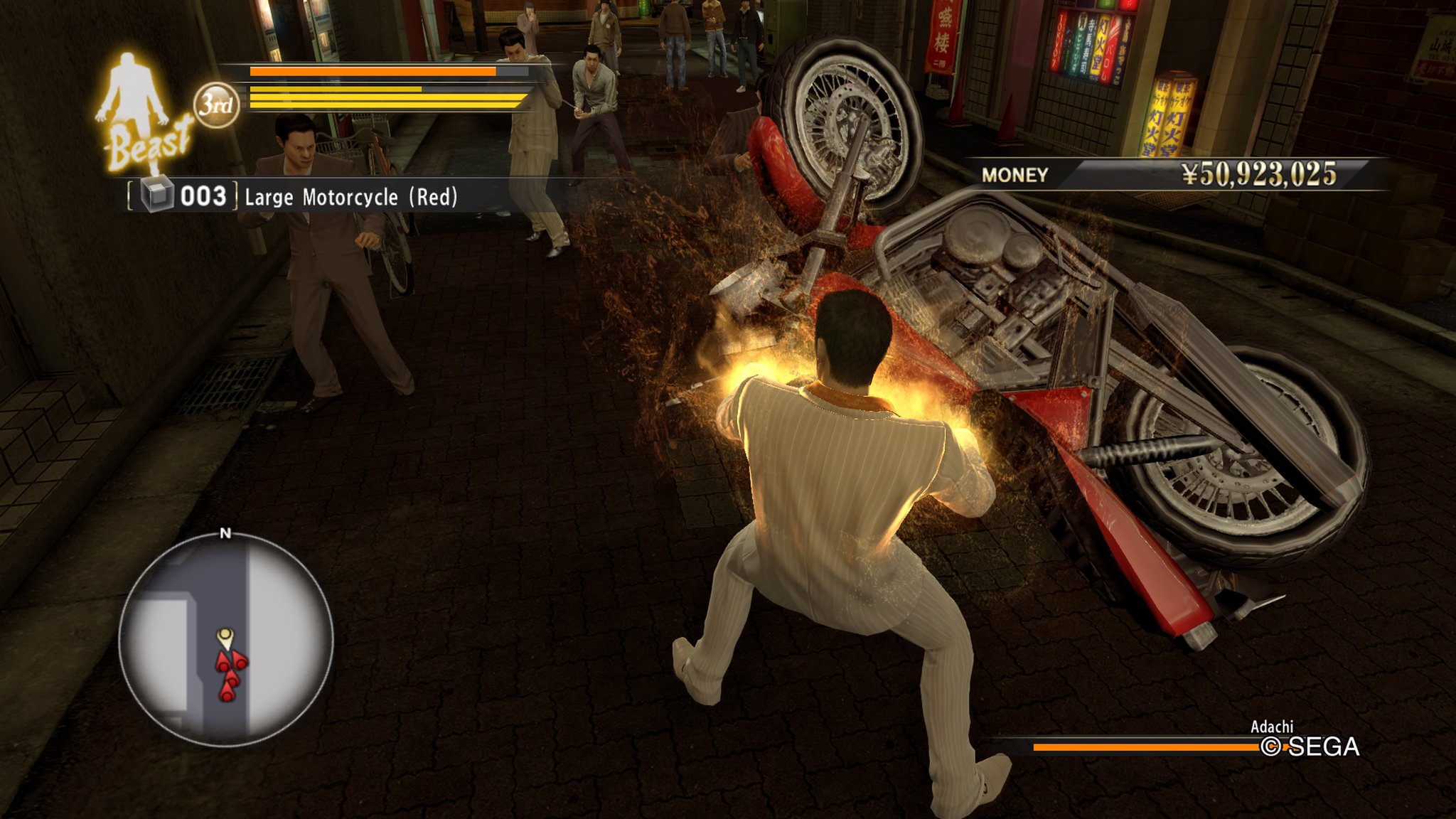
Kiryu’s Beast mode in action.

Kiryu’s Beast mode allows for slow but heavy attacks in a wide range, as well as a number of wrestling-inspired finishers.  More importantly, it also allows for automated grabbing of environmental objects to swing at enemies, including things like motorcycles.  On Majima’s side, the real standout is Break mode.  This uses a series of breakdancing moves to quickly and heavily take out large groups of enemies through effective AoE attack and dodge maneuvers.  In general, I was able to switch to a mode that made sense for each fight, whether I needed to do heavy damage to individuals, or keep it safe while whittling down a large group.

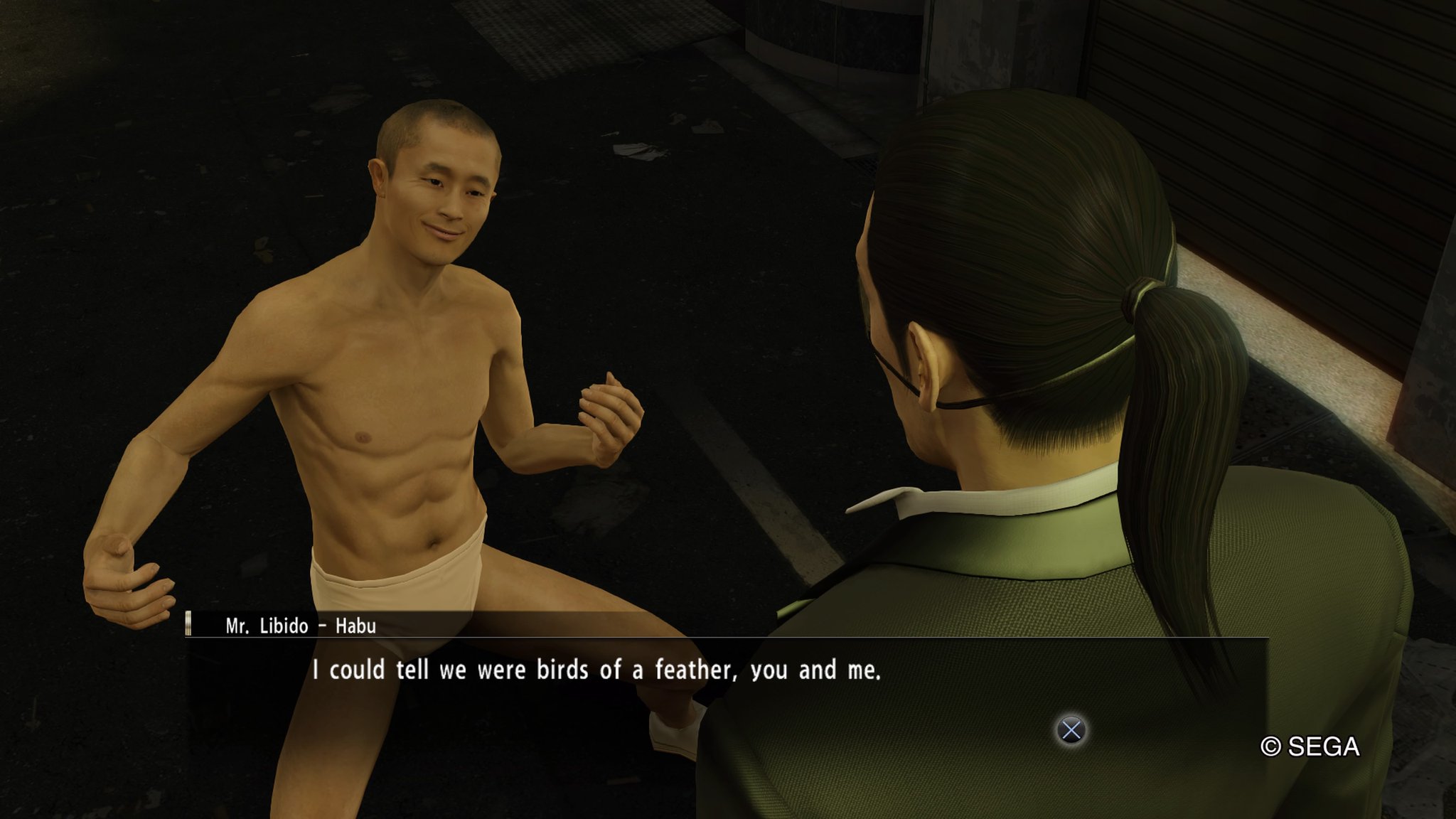
Mr. Libido in action…

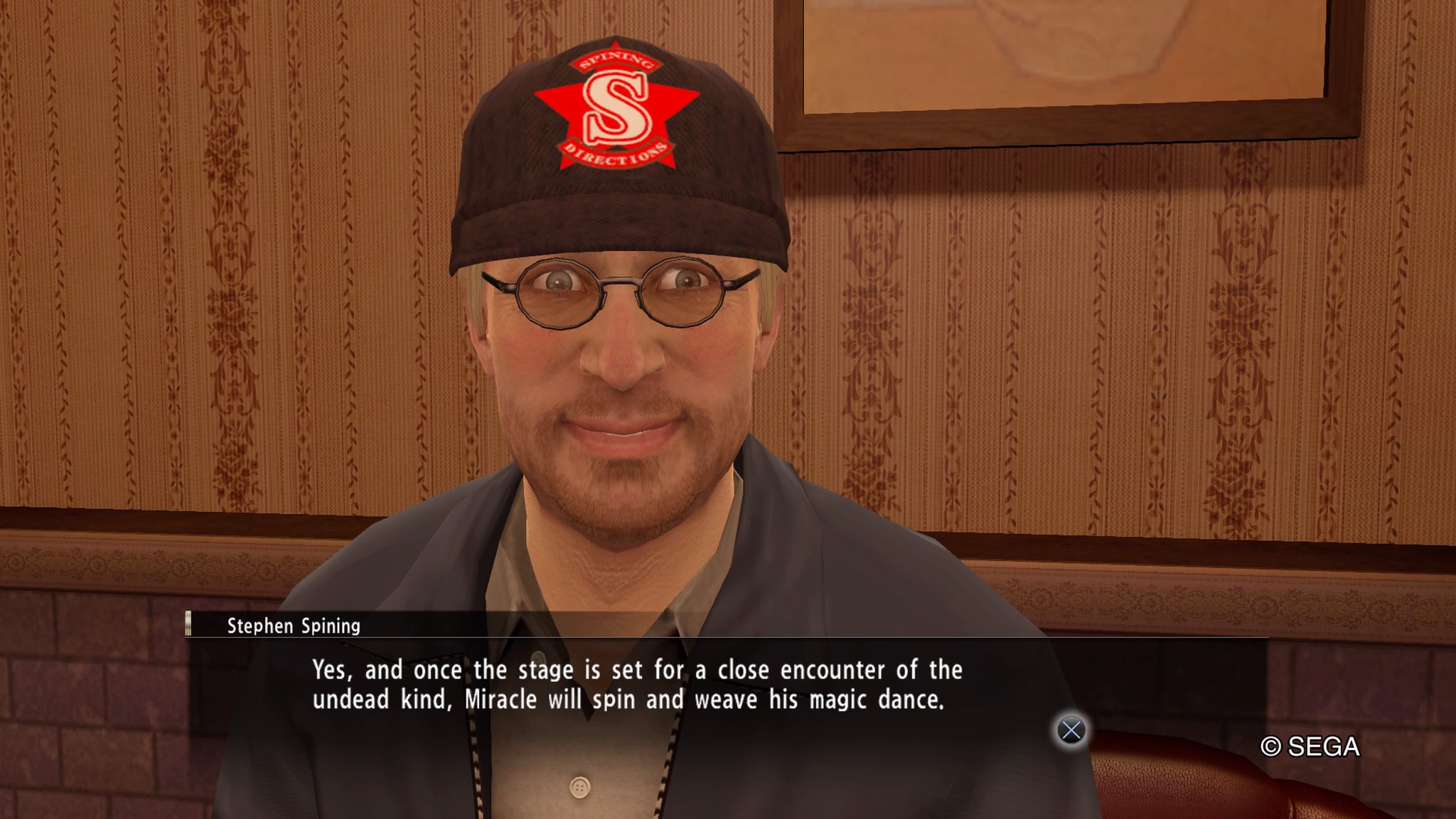
On the story end, there’s not too many surprises here, but it’s definitely entertaining.  The more surprising thing for me was the mix of the serious story with incredibly non-serious side missions.  The side missions typically had similar gameplay, but the characters you meet during them were generally absurd, whether it’s Mr. Libido being unable to contain himself, helping out fake Michael Jackson and Steven Spielberg make Thriller, or Kiryu mixing up visas and pizza when helping an immigrant, I could pretty much expect side missions to go straight for the absurd.  Given the seriousness and level of chaos that most of the main story had, it meant I could use the side content as a way to unwind between places where I knew I could get into big fights.  This is backed by a surprisingly entertaining set of real estate content for each character to add even more depth to the things to do on the side; Kiryu runs a full real estate company and Majima runs a cabaret club.

Totally not Spielberg stares into your soul.

If there was anything I would directly point to as a severe negative here, it’s that at a number of points the story missions simply don’t tell you what to do.  You’d be given a vague goal (find somewhere to hide!), with no map marker, and no obvious place to go, and be forced to wander around until you hit the magic trigger.  More often than not these places would be triggered in areas where you had no NPC contacts, no reason to be in the area, and would never revisit the place for any other reason.  While filling gap time between story missions doing side content allowed me to accidentally wander into these from time to time, I was still forced to effectively blanket the map covering all roads until I found the specific spot.  Any sort of minimizing of the vague nature of these would have been a great help, but luckily these types of missions were the minority in place.

Overall though, Yakuza 0 was a ton of fun to play.  The combat was solid, the story was enjoyable, and the side content had a lot of flat laugh out loud moments. If you’re wanting to play a Japanese GTA, this is not the right game, but if you’re looking to rekindle memories of playing Shenmue, this is a great place to start.

Game Ramblings #36 – Horizon: Zero Dawn

More Info from Guerrilla Games

  • Platform: PS4
  • Genre: Open World Action/Adventure

I really felt like I need to hold off on posting this for a while.  It’s not that the game was bad; realistically it’s already likely to be top 5 for the year.  It’s not that I was necessarily unexcited to finish; I really felt compelled to keep going through the story missions.  It’s just that the end of the game so entirely infuriated me that I didn’t think I could give this one a fair shot right in writing if I didn’t let things settle for a while.  If there’s any crime that this game was actually guilty of, it was coming out the same week as Breath of the Wild, which at minimum provided a hugely good benchmark to compare it against.  Luckily Zero Dawn didn’t stumble, even if their launch timing was pretty poor.  So with that said, let’s get the good out of the way first, because there’s two main things I really want to rant about, but are ultimately unimportant to the quality of the game.

This game really nailed the future post-apocalypse setting in a way that a lot of games fail to do.  It mixes a fantastically beautiful open world landscape with very obviously hi-tech robotic enemies to fight against to provide a great starting background for a people that are obviously not the ones in control of the technology.  As the story unfolds, it becomes a fantastic telling of an AI clearly gone wrong, and how the world came to be in the state that it’s in.  By mixing in obvious landmarks, scannable audio and holographic logs, and ruins of cities of the past, the world’s depth grows in a way that I’ve only rarely seen in games like the Metroid Prime series.

This world is backed by an open world gameplay style that definitely hits more than it misses.  There’s definitely some typical trappings of open world games – towers that reveal the map, optional items scattered around to collect, hidden dungeons to explore – but it’s nothing that gets in the way, and the developers at Guerrilla definitely minimized their use to avoid some of the tiring grind that I would typically see of the genre.  The real highlight though is the robots that you fight.  These start as small as small as elk, big cats, or hyena type robots that can be stealth killed.  From there things grow tremendously until you’re fighting gigantic crocs, T-Rexes, and huge eagles.

The larger monsters themselves greatly depend on the use of ranged weapons, and this is where a lot of the weapon upgrade path is focused.  There’s things like your typical bow and arrow, providing decent damage on the run.  There’s more focused heavy-damage bows that trade much slower reload for heavy damage or heavy part stripping capabilities.  There’s slings that can throw various grenades with different elemental, sticky, or proximity attack characteristics.  There’s even a set of crossbow-style weapons that let you lay rope traps in preparation for taking down an enemy.  Despite all being ranged weapons, the tremendous breadth of capabilities means a normal fight may have you switching between three or four weapons on the fly, stunning an enemy, laying some traps while it’s down, then taking out pieces of its armor until it’s dead.  There becomes a pretty strong rhythm to the normal fights that gets hit here that most open world games have never really gotten this right.

The unfortunate thing is that my overall enjoyment was clouded realistically by two things that should not have been a big deal.

The first problem I ran into was the lack of melee weapon progression.  You gain your first melee weapon right at the start of the game, using it for close-in attacks, as well as single shot stealth kills.  This becomes a tremendously fun way to get kills early on in the game, luring enemies into tall grass and killing them in one blow.  However, beyond a handful of small skill point upgrades, there is no melee weapon upgrade until very nearly the end of the game.  As the enemies you face become stronger, even smaller enemies can no longer be one shot, so I ultimately started avoiding packs of enemies because the risk vs. reward was no longer worth getting into multi-enemy fights.

The second main problem was the general design of the boss fights.  Pretty much without exception all the boss fights were just kind of boring.  The fights pretty much all followed the pattern of

  1. Cluttered circularish arena with too many things that block dodge rolls
  2. Giant enemy with predictable patterns
  3. No reason to move into melee range because the melee weapon sucks against bosses and ranged is much safer

Ultimately though, I would get through the boss fights because exploring the rest of the world around me was just so much damn fun, and it made it worth playing the game.  At least it gives them some things to clean up for the sequel.

Game Ramblings #35 – The Legend of Zelda: Breath of the Wild

More Information from Nintendo

  • Genre: Action/Adventure
  • Platform: Switch
  • Also Available On: Wii U

I kind of expected this one to not live up to the hype, especially given the reviews it was getting up to release.  However, for me it definitely nailed it.  Even given the quality of past Zelda games, this is a tremendously special game.

As far as open world games go, there’s a certain set of expectations involved with what you’re going to see as a player.  Most of them have some form of collecathon of things all around the world, a relatively loose structure in how you get between different quests, and more recently, some way to reveal portions of the map to the player as they explore.  Breath of the Wild certainly sticks to some of these conventions, but in doing so they’ve also shaped the conventions in a way that make the game still feel distinctly Zelda.

Nintendo went all the way with the story being entirely open world.  Once you finish the tutorial you’re given a couple quests as is typical of the genre.  What isn’t typical is that one of them is literally to go kill Ganon.  From this point forward, you can either explore and do things that will expand your repertoire, or you can literally go finish the game.  More than any other open world game I’ve played, this very quickly establishes the expectation here.  You can do whatever you want, whenever you want, and finish the game whenever you feel like it’s time to do so.  Everything else that is typical of Zelda games falls into this setup.  What also isn’t typical is that the tutorial gives you all of the items and skills you will earn within the game, upgrades not withstanding.

Despite some of the lead in news, dungeons are there, but you have to earn your way to them, and they can be done in any order.  The dungeons themselves focus more on puzzles than combat, and tend to be somewhat shorter than past games.  However, what they lack in length, they make up for in quality.  The core theme here is puzzles tied to environment manipulation.  Upon completion of the core puzzle, there is of course a boss fight, this time acting as proof of mastery of the skills earned at the start of the game.  While not being a necessity anymore, the quality of the dungeons absolutely made them worth completing, if for no other reason than the story elements they provide showing the past of the world.

It’s also worth nothing that despite the reduction in dungeon count and size, the world itself provides more than enough to cover this missing element.  Within the world you can find over 100 individual shrines to complete, as well as towers that provide the map viewing coverage typical of open world games.  While these things do provide the way to fast travel, these are also the main puzzle element present in Breath of the Wild.  Each tower tended to focus one on specific skill in manipulating the environment to get to the point where you could climb and complete the tower.  On the other hand, each shrine effectively acts as a fantastic mini dungeon, with a huge variety in what is available.  These ran the gamut of what was available in the game.  Some of the shrines were just simple combat rooms.  Some shrines had a focus on individual skills like manipulation of air for gliding, or the use of fire-based weapons to burn a path to the end.  Still some of them were there purely for amusement, like one physics-based minigolf shrine.  While completing the shrines did ultimately give rewards that resulted in heart and stamina upgrades, they also provided a nice way to break up the game as I traveled around the world of Hyrule.

Despite all the changes from the usual Zelda formula, the one that was most striking to me is how they changed the use of music in the game.  Outside of towns, there is hardly any music, apart from some sporadic piano melodies.  Even within towns, the music was typically fairly subdued, and the bulk of what could be called the soundtrack was composed of ambient noise from the abundant wildlife throughout the environment.  When the music does kick in though, they definitely aren’t shy about bringing in some hints of the past whether it’s night or day.  Overall while it’s not as in your face as is typical, this soundtrack is another memorable one in the books for this series.

What became quickly apparent playing this game was just how polished it was, and it’s always in the little details.  There’s a ton of wildlife around, and it’s not just there for show.  It can be hunted, and the supplies you earn from doing so can be cooked into food to heal Link in battle.  Because you CAN climb anywhere, you end up climbing just for the sake of it.  Because shrines are then typically glowing orange against the background, climbing anywhere typically gives you new goals on the horizon to go for, further providing you with new things to do.  Large scale bow aiming with the analog stick is there, but subtle motion controls provide an extremely fast and precise way to accurately aim in small amounts for things far in the distance.  Camps of enemies can be cleared in straightforward combat, but it’s also just as practical to roll a rock down a hill onto the group, send fire arrows into explosive barrels, or lead enemies into traps by chucking bombs into their midst.  Those are all little separate things, but I hope it’s making my point here.  The amount of polish in place is of a level that only a few other companies ever attempt to approach. This is on a level typical of companies like Naughty Dog or Rockstar, and I’d dare to say it surpasses them.

All that said, weapons that can break are still a terrible idea.  It’s not that weapons are hard to find in BotW, but when you’re trying to fight a boss and you run out of weapons from lack of preparation, it can be extremely frustrating.  This did push me to collecting Korok seeds to upgrade my inventory, and by the end of the game was a non-issue, but boy were early large scale fights super obnoxious when weapons started running out.

I’m the type of person that will pretty much buy hardware on launch without fail.  Regardless of how many games are coming out, there’s going to be something in there I want to play.  What is rare is that I recommend other people to buy hardware just for one game.  Breath of the Wild is one of those.  If you have neither a Wii U or a Switch, you should get one just for this game.  Go grab a system for yourself or go grab one from a friend.  Just find a way to go play this.