Game Ramblings #50 – Uncharted: The Lost Legacy

More Info from Sony

  • Genre: Action/Adventure
  • Platform: PS4

TL;DR

  • Same ol Uncharted gameplay, over the top action sequences, and beautiful visuals
  • Short length meant the story didn’t drag out, which felt like a plus
  • First half showed some growth in their design w/ an almost Tomb Raider semi open world.

I’m not going to sit here and say that this is a hugely original title for the series.  I’m also going to be straight here and say that the changes in The Lost Legacy feel a lot like copping some features from Tomb Raider.  However, this very well might be the best Uncharted title I’ve yet played.  It being a condensed experience certainly helped (about 6-8 hours I’d assume will be typical first play through), but a nice use of a large non-linear area to start the game went a long way to providing a fresh look at the series, and may just prove there’s life to be had in this universe.

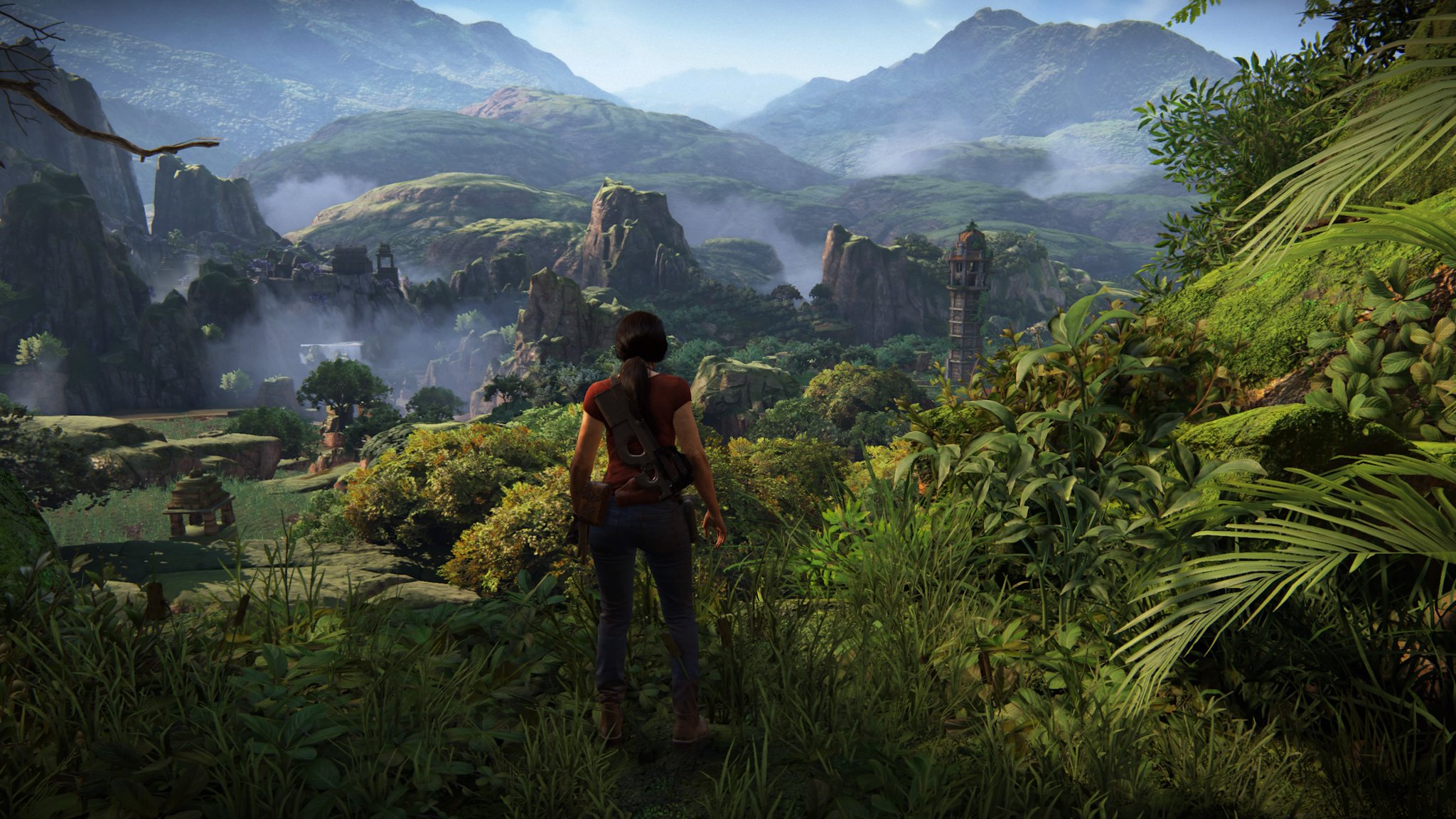
Like previous Uncharted titles, this is another visual masterpiece.

There’s a lot to be familiar with here. The gunplay is still good, but nothing mind blowing, going for solid feel without too much difference between core weapon types.  Combat sequences in the more linear segments are still at obvious points when you turn a corner and have a ton of crates around.  Enemies are still decent but basic in their approach to flanking behaviors.  The game’s finale (and a couple points in between) is still a wildly bombastic experience that would feel at home in any big budget Hollywood film.  End of the day, this is still Uncharted at its core, but with a big difference in the first half that showed some progress.

Roughly the first half of the game takes place in a large open area, with a set of non-linear objectives to drive to, and a bunch of hidden collectibles to find in the area.  This alone felt like a fantastic change to the series, even if it felt right out of the recent Tomb Raider games.  Because of the layout of this opening area, combat also felt much improved relative to the standard single direction combat of the linear exploration areas typical of the series.  Combat segments felt very free form, since you could approach from basically any direction, and enemies could do the same.  In a lot of these areas, I’d be stealthing around to find a good entry point, then doing what I could to pick off enemies one by one without revealing my location.  If things started to go awry, many of the areas also had a lot of swing points, so I could easily move around to find new hiding spots if enemies started to get a drop on me.  In general, this was the best I’ve ever seen combat in the series, although it unfortunately went away once the more linear segments of the game started.

While not as complex as the Tomb Raider series, the side exploration in the opening area was a welcome addition to Uncharted.

The unfortunate thing though is that the opening area gave way to more traditional Uncharted linear mechanics.  While this works fine in the general sense, it feels like they missed an opportunity to really make a special full entry in the series based around the gameplay changes of the first half.  The puzzle areas of the linear temple portions worked great, but it was back to the more boring combat style and tiresome climbing areas.  Realistically I can only do the same pattern of climb, jump to crumbling wall hold, fall down to conveniently placed grab spot, then finish climbing up so many times.  On the other hand, the fact that this is a much shorter expansion-style game meant that the experience was fantastically condensed before I really wanted to just get through.

End of the day you kind of know what you’re getting into here when buying an Uncharted game, and this one doesn’t differ much. It shows some promising changes in the first half should Naughty Dog decide to continue with the series, but never really expands on the changes for the full length of this game, let alone makes a full game out of it.  However, treated as an end of summer blockbuster experience, this is still just as worth playing as the previous entries and definitely left me entertained, and that’s about all I can ask for.

Shelved It #7 – Hollow Knight

More Info from Team Cherry

  • Genre: Metroidvania
  • Platform: PC
  • Also Available On: Mac, Linux, Switch

TL;DR

  • Solid mechanics, solid visuals, solid audio all put together a great base that can be built on.
  • Small bits of lack of polish, rather than anything egregious led to frustration, and eventual shelving.

This is going to sound weird for a game I’m shelving, but Hollow Knight is really quite good.  It’s a pretty traditional Metroidvania in layout, using a solid short-range melee system and some occasional powerups to round out the move set.  This is complemented by a solid visual style, and great audio and soundtrack to put together one of the best themed titles in this genre I’ve recently played.  However, this was a case of a thousand cuts, where small lack of polish in the details led to a continuous pattern of one step forward, one step backward in my progress.  This was combined with a somewhat questionable use of the Souls death mechanic, to where body runs began to feel like a slog, rather than a good balance of penalty and learning reward.  In the end, the good couldn’t outweigh the bad for me to continue on.

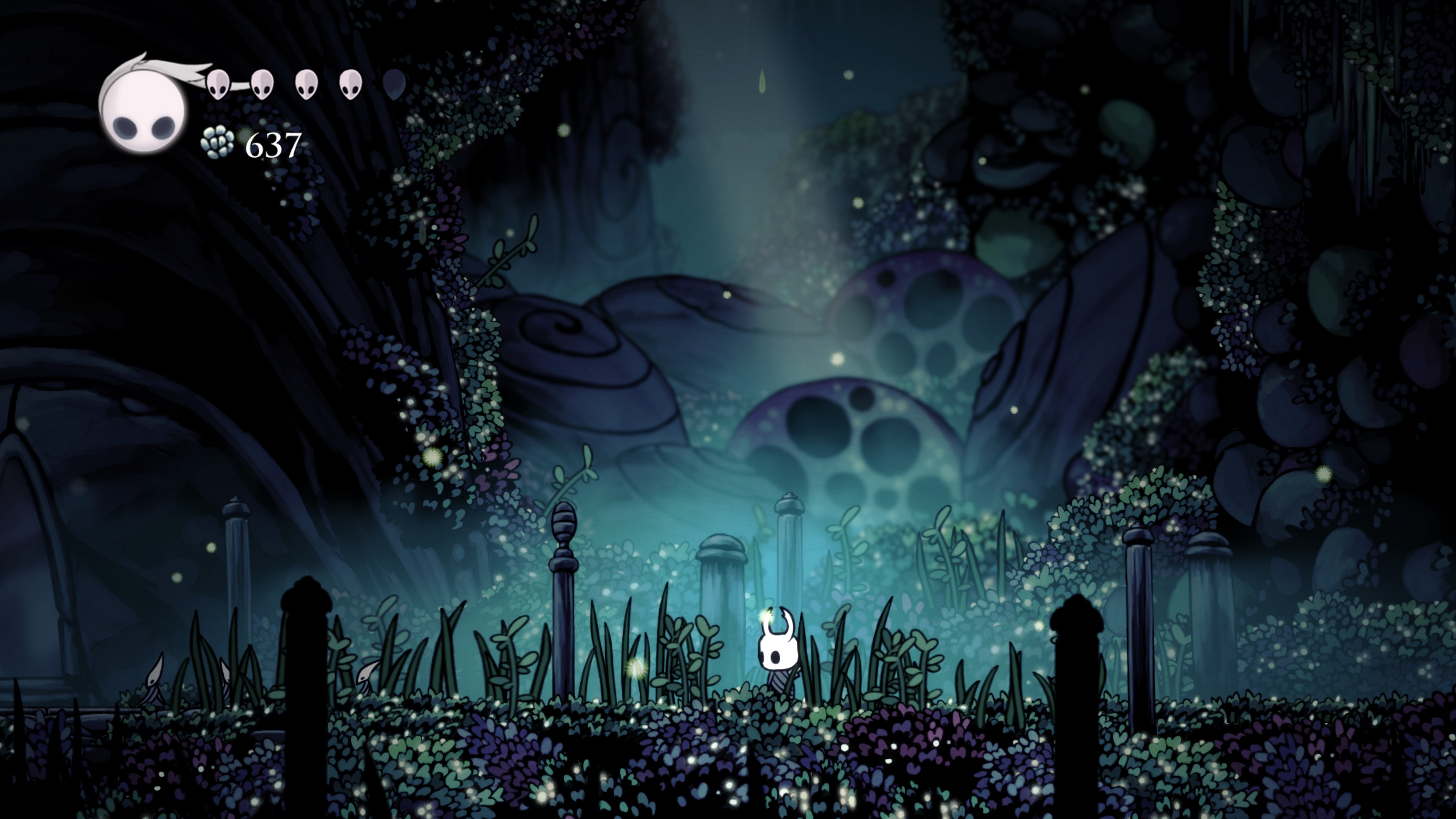
Early example of some of the fantastic visuals you’d see in this game.

However, let’s start with the good.  As with a lot of recent Metroidvania games, particularly in the indie scene, this one is a fantastic looker of a game.  Like the recent remake of Wonder Boy 3, or other Metroidvania titles like Ori and the Blind Forest, this one has a fantastic visual style.  Everything has a great hand-drawn appearance, with thick painterly lines.  It’s a fairly distinct style, and works rather well.  This is combined with great use of dynamic lighting to give some dramatic areas.  The biggest problem with it all is that most of the areas share a similar color range, so things can begin to look rather samey as you continue on.  On the other hand, it never got old running through the environment and having all the little blades of grass in the scene explode into similarly styled particles as I swung through them.  As a whole, this was a part of the game that never really diminished in my time playing it.

The core combat is also really well put together.  The base of the combat are melee strikes, which sounds simple at its core.  However, there was a smart choice made specifically in the horizontal strike, giving some verticality outside of the swing’s hitbox, and allowing players to hit things both slightly above and slightly below without having to be super precise with jump heights. This was extremely nice for how small some of the hitboxes on armored bosses and enemies could be.  This was backed up by a strong set of spells and abilities that are earned throughout the game to fill out the move set.  Examples here include mid-air dashes and double jumps for traversal, or energy missiles and dive bomb spells for damage.  Generally speaking, the game gives you a bunch of tools to use, and its up to you to then figure out what is most effective for each situation.

However, as I continued on, the little details that didn’t quite have the polish of the visuals and core combat started giving way to more frustration than fun.

The first big place this showed for me was in their use of the Dark Souls death mechanic.  The basic system is that at death, your soul gets stuck in the world along side all currency you earned during that life.  If you get back to the soul and defeat it in combat, you earn all the currency back.  If you die before that, you permanently lose all of it.

Generally speaking, I’m pretty neutral on this system.  There’s a fine line where this system works well, and to me it requires enough save points in place that are both close enough together, as well as close enough to where players will die so that the game doesn’t heavily discourage exploration, and keeps game pace post-death high.  To me it feels like Hollow Knight fails on both of these counts.  Many areas had a bunch of save points clustered near the center of the zones, but fewer out towards the edges where a lot of boss battles or more dangerous sort of side dungeons were.  There were also hardly ever any save points actually immediately before or immediately after boss rooms, so deaths during bosses (which are extremely common) often resulted in a long run back to the boss.  It just felt like a lot of wasted time, rather than a good chance to learn and retry the boss quickly.  This was compounded by a number of times where my soul spawned out of reach, effectively ending my change to re-earn my lost currency, so I eventually just stopped exploring altogether, choosing to go the lower risk way of sticking to main paths and simply grinding out kills if I required more money or power for skills.

There were a bunch of other little details that also compounded on top of this core problem for me.  First and foremost, jumping feels awkward.  This is a game with purely digital left/right movement, and no in-air momentum.  If you’re jumping and let go of the stick, you fall straight down.  It just feels weird, and eliminates a lot of subtle movement flow that a lot of better examples of the genre have.  There’s also a really obnoxious backwards impulse after hitting an enemy.  This is combined with somewhat imprecise collision on platforms to put me in situations where trying to jump and hit enemies mid-air around small platforms was pretty much a death sentence if solid ground wasn’t below me.

The final sort of annoyance was in the mapping system mechanics.  Rather than mapping out rooms when you walk through them, you had to clear a couple of hurdles first to map out a zone.  First and foremost, you had to buy a map of the zone from a vendor within the zone, generally well within the zone and out of the way (see annoyance with losing currency when your body run fails due to spawning out of reach….).  This only opened the ability to map the area.  It then didn’t mark areas on your map until the next time you reached a save area (see annoyance with the location and frequency of save poiints….).  Otherwise you were basically flying blind, and have to remember your path through areas until you hit both points above.  Generally speaking, it just felt like an additional unnecessary money and time pit, where I’d rather be spending my currency on functional upgrades.

End of the day, the further I went into Hollow Knight, the more the small details outweighed the good of the core systems.  Could I have grinded through it without too much trouble? Sure.  Are the problems going to be something that bothers everyone? Nope.  However, I’ve got plenty of other games to play, and seeing lack of polish in the details just generally distracts the hell out of me.  However, for those with more patience than me can probably find a lot to love here, so if nothing else, I’d recommend taking a look the next time a Steam sale rolls on through.

Game Ramblings #46 – Yonder: The Cloud Catcher Chronicles

More Info from Prideful Sloth

  • Genre: Adventure
  • Platform: PS4
  • Also Available On: Steam

TL;DR

  • Fantastically gorgeous environment and great soundtrack
  • Main quest line that’s entertaining to play, and gives you the right amount of push to continue seeing the new environments
  • High end crafting and side quests are fundamentally problematic with the game loop as implemented

Yonder is a game that at its core feels like it was made by a group of artists.  The attention to detail in the environment is up there with some of the best games available this generation.  The soundtrack backing it is the right level of ambient orchestral music without getting in the way.  All of this is tied into a fantastic implementation of a day/night cycle very reminiscent of its use in Breath of the Wild.  However, once you go beyond the core story quest line, the lack of real depth to the game systems in place, and a crafting system that is more menu and resource frustration really shows the problems that come out in the game loop that’s available.

One of the first areas you see in the game.

Right off the bat, it’s clear that this is going to be a beautiful game experience.  After an initial intro scene and cave crawl, you immediately get out into an open field that gives you a vista of a large part of the island the game takes place on, and it’s astoundingly beautiful.  The characters and animals around have a simple but effective style, and everything is fairly recognizable right off the bat.  Each area that you go to throughout the game then has its own core visual theme, whether it’s the snowy areas as you climb the central mountain, the palm trees near the beach, or the sparse rock formations in the desert.  Each area is just as great looking as the one you just had left.

Night time looks just as great.

Things look just as great when you hit night time.  The sky grows dawk, constellations fill it, and the player’s character breaks out a torch to give some local dynamic lighting around.  At the same time, the music drops in intensity, and you really feel the encroachment of night time around you.

The core gameplay itself is built around an effective set of collection and crafting quests.  The main line is pretty straightforward, with a series of quests that basically lead you into visiting each area, collecting Sprite creatures to clear off the Murk attacking the island, and collecting parts to fix the Cloud Catcher from the title.  By and large these serve as a way to get you to the towns that hold the various crafting type masters, and allow you to expand your repertoire or skills, which lead into further use through side quests.  While there are some systems in place on the side dealing with farming, it’s not deep enough to serve as a long term distraction.  This along with the nature of the side quests really starts becoming the main problem in exposing the larger issues with the core of the game’s systems.

The side quests take the core collect/craft mechanic of the main story line, and ramp it up to 11.  The problem is that the crafting system in general is just not that good, and the collecting of resources in the environment is kind of a hassle.

Materials used to craft a single bridge…

As an example, I created the above list to try and wrap my head around what I needed to craft a single bridge.  At the highest level, this thing required somewhere around 300 stone, and a bunch of other various ingredients.  The big problem is that stones can either be found solo on the ground, or in groups of 4 that can be mined out of a single boulder.  Just from a length of time to collect, this then becomes rather time prohibitive.  It also means hopping around to a ton of different areas in the crafting menu to craft individual pieces, then larger pieces, then larger pieces where each tab in was another level down in the crafting sequence.  For me, there was also the fundamental problem of not really understanding why something that uses parts made out of stone then requires MORE stone.  Even as it currently exists, being able to pick the high level item (say a stone arch), getting a total list of ALL resources needed to build it, then being able to one shot complete the project would have significantly improved the experience, as opposed to the current mess of crafting large items.

Scenes like this pushed me to keep playing.

End of the day, the main reason why this was not another entry into Shelved It has more to do with the fact that the game was abrupt in finishing, and I wanted to see what else the environment team had put together.  While the base that is there has potential, there’s too many fundamental problems with the crafting and collecting systems that are the core of the game to really consider this one worthy of high praise.  On the other hand, given the lack of content, a few changes to the way these work could fairly quickly elevate this one to a pretty entertaining and relaxing adventure title.  However, if you really want to see a gorgeous game, it may be worth taking a look at anyway.