Game Ramblings #82 – Tales of Vesperia: Definitive Edition

More Info from Bandai Namco

  • Genre: JRPG
  • Platform: PS4
  • Also Available On: Xbox One, Switch, Windows
  • Originally Released On: Xbox 360, PS3 (Japan only)

TL;DR

  • Roughly decade old Tales of title remastered for current generation, first time seeing expanded PS3 content in North America
  • Game that has aged well despite some of the improvements to the overall Tales of gameplay since its release

I had the weirdest lack of memory about the second half of this game as I was playing it, as if I hadn’t ever gotten that far in the original release. This is despite me basically finishing all Tales of titles since Symphonia. From playing it this time, I knew it wasn’t because I didn’t enjoy the game – the combat in this entry is probably what I’d consider the best representation of the more classic side-scrolling Tales of combat. I also know it wasn’t because of a difficulty spike as I never really had a point where I felt like the difficulty curve was anything but correct. At the end of the day I never did figure that out and I never hooked up my 360 to figure out how far I had originally gotten, but in my 50 or so hours with this game, I came away knowing that this still holds up as a fantastic RPG worth playing.
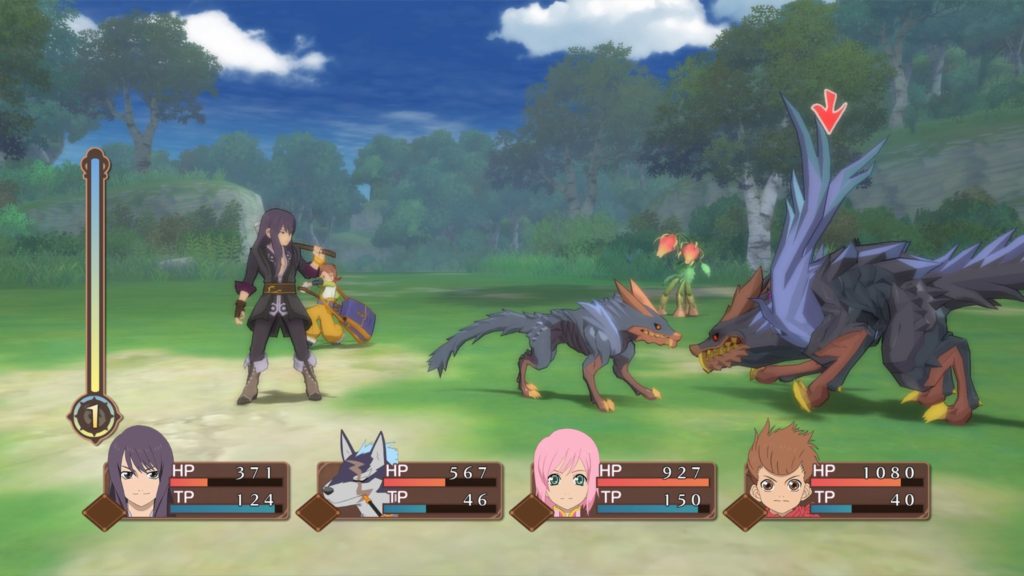
Combat is still the main focus here to no surprise.

Combat in Vesperia is about as close as I could point to this series’ classic combat style still playable on a modern platform. Games after this added new elements that really played with the system – Graces removed TP and added a bunch of side stepping, Xillia played around a lot more with a 3D battle space, Berseria played around with swapping characters in real time while pushing further into 3D. Basically, Vesperia pretty closely represents the end result of years of them iterating on a 2D system, and it is still a thrill to play.

The main focus here is still some really fun and fast paced combos consisting of basic attacks and special attacks. Where this game really pushed things is in the use of gear skills. Some armor, and nearly all weapons have skills that can be earned over time. Once earned, the character permanently unlocks the skill as a toggleable item. These can range from passive stat boosts to attack replacements. The real fun ones for combat end up being the combo modifiers.

These can extend your combo, make parts of your combos different elements, make parts of your combo scale better and more. It basically becomes an involved metagame in trying to build out your attack combo in a way that best suits your style in order to maximize both damage, and in many ways maximize the amount of time you can stun lock your opponents. After all, more stuns equals less damage taken equals better chance at winning. The balance here is incredibly rewarding when you find the skill setup that best meets your style, and gives a lot of flexibility to the player in fighting specifically how they want.
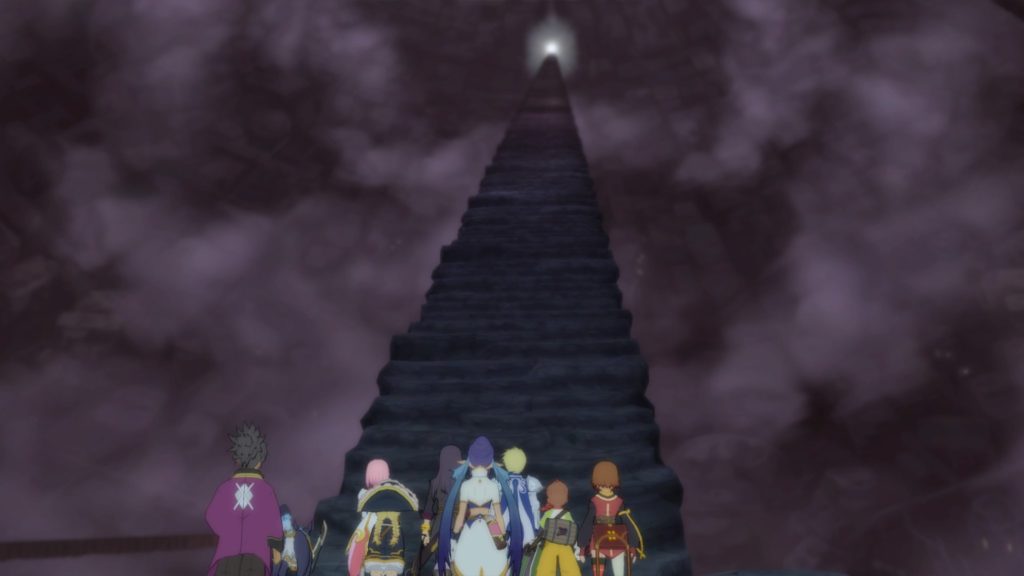
Get used to these guys, you’ll be spending all your time with them.

That’s not to say that all parts of the combat system have aged incredibly well, but they’re in ways that are sadly familiar to Tales of players. The AI in general can basically be depended on to do the worst thing possible, even if you tweak their AI setup. In the end my best course of action was usually keeping one person on full time healing, and not allow them to attack, thereby keeping them out of danger and having to focus on healing only themselves. The other AI generally had their best result in using ONLY basic attacks, or they’d sometimes stand around just waiting to use skills. I’d much rather them be doing basic attacks to stun the enemies, and allow me to run around doing larger damage under my own control. The stun locks also work both ways, with some of the later bosses being basically stun lock management and a setup where I spent more time free running avoiding attacks, then doing poke damage when possible instead of actively being in combat. In a lot of points bosses can basically stun lock you 100->0 if you get hit with the wrong thing and your AI partners don’t interrupt the chain.
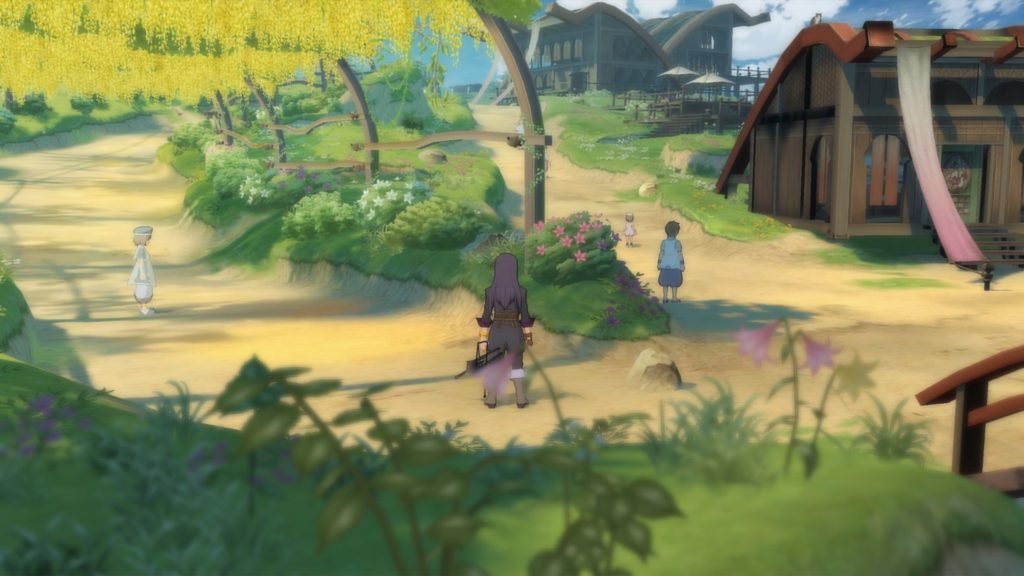
Visually the game has held up well, with a few more modern enhancements keeping this one up to speed despite its age.

The rest of the experience is unsurprising. Visually, the anime style that the Tales of series has always used has aged really well. The resolution bump on the new consoles has helped out a bit, and some light use of depth of field and similar screen effects has given this a bit more modern flair. The story is a bit take it or leave it, with the usual amount of incoming apocalypse melodrama typical of the series. However, the characters are generally likable and the banter between them is a lot of fun. This one also has pretty solid voice acting, and the entire set of skits has also gained the voice acting done for the PS3 Japan release. Overall, this one really didn’t need to do much to still hold up, but the little pieces done to remaster the title keep it up to modern expectations for the series.

I guess my end recommendation here is basically to play this, especially if you’ve liked any of the Tales of games on modern consoles. The battle system would be a bit different than those, but still has great flow despite its often 2D nature. The gear skills in particular are a customization wrinkle that I wish more games in general would take advantage of. The rest of the experience is typical of Tales of games, and that should frame whether or not you think you’d like it. However, even having played it before, I still put the 50 hours in to finish it again so that should give the best kind of idea of how much I think this is worth playing.

Game Ramblings #76 – Dragon Quest 11: Echoes of an Elusive Age

More Info from Square-Enix

  • Genre: JRPG
  • Platform: PS4
  • Also Available On: Windows, 3DS (Japan Only)

TL;DR

  • Pretty traditional turn-based JRPG typical of the series, with a few nice modern features brought in
  • Fantastically gorgeous game thanks to using UE4
  • Solid story that kept me pushing forward, even if the “true ending” path got unnecessarily grindy

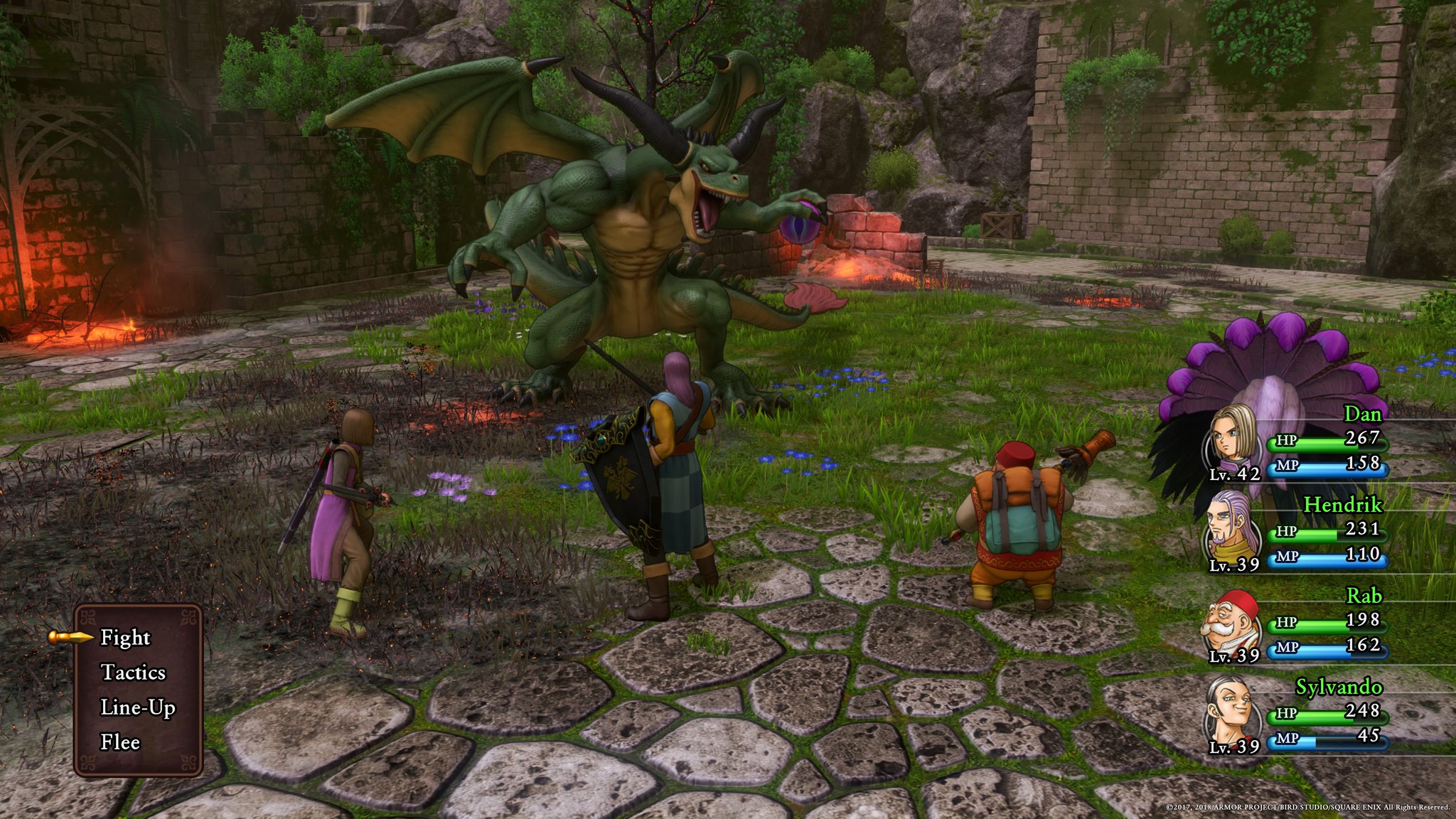
I’m pretty sure  I’ve made note of the fact that I’m a sucker for JRPGs in the past, and Dragon Quest 11 is about as JRPG as it gets.  The story is nonsense, the battles are strictly turn based, the grind is real, and the characters are still default Akira Toriyama.  Despite it all, this is clearly a modernized entry in the series from the visuals to some of the little gameplay elements that improve the overall experience, and it ends up going a long way to finally bringing the series into the current generation.

Combat is definitely familiar to traditional JRPG fans, but there’s a few nice things to minimize the tedious nature of this style.

Since this is a JRPG, I’d be remiss if I didn’t start with combat.  This is definitely a very traditional experience, even within the Dragon Quest series.  Turn order is based loosely on an effective speed stat.  Player characters have their basic attacks, skills, and magic attacks.  The general class archetypes of warrior, thief, mage, healer, etc are all present and each character definitely has their strong suit.  Behind it all is a skill tree for each character that the player can customize via skill points earned at each level.  Basically, it’s what you’d expect from a JRPG.

However, it’s the little things that this game brings that make this game an obviously more modern approach.  Auto battle makes its return from DQ9 to keep the pace of individual fights moving along.  It allows for setting priorities on how AI react, or can be turned off entirely on a per-character basis if more decision making detail is needed.  The party line up AND equipment can be changed at any time from within battle, allowing for very detailed strategies on harder content if a party or equipment setup isn’t working well.  Even more importantly, characters not in the active party gain 100% of XP from a fight, allowing the player to focus on the style that makes sense at the time without severely penalizing them for not using all characters at once.  In general, this is following a pattern of traditional but modern that is seen in a lot of other areas of the game.

I think most importantly though, this game has auto saves at pretty much every door and cutscene.  I couldn’t tell you if this was a technical or gameplay consideration, but simply knowing that I wasn’t going to lose a ton of progress to a boss death was a huge improvement to my overall play.  Rather than worrying about finding a save spot before a boss or worrying about my level, I simply always did boss fights.  Generally speaking this was fine and I would get through fights.  For a good portion of them, it also meant that I was going into fights at a challenging level, rather than grinding a bit more just to  be safe.  Overall it resulted in two really important changes to my usual JRPG game style; I did a lot less grinding so the game didn’t drag, and because of my level I was able to enjoy the challenge of level-appropriate or even underleveled fights without caring about whether I was going to die.  It may sound weird, but it just made the game more enjoyable knowing I was going to play this way.

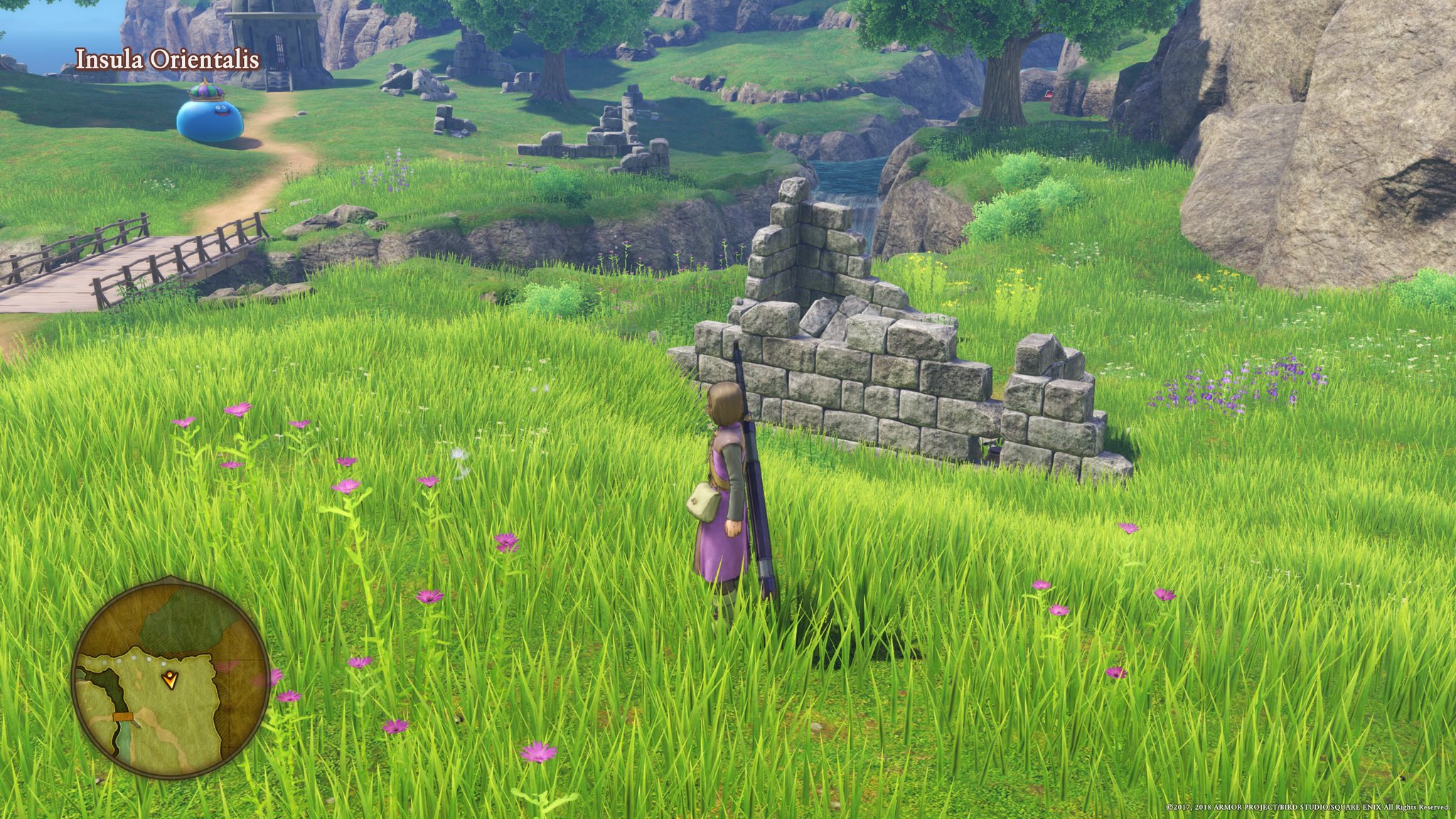
Visuals are definitely distinctly modern. It’s obviously Dragon Quest, but it’s gorgeous.

The non-gameplay elements also fit well into the traditional but modern approach.  Visually, this is probably the best looking JRPG I’ve played, hands down.  Games like Final Fantasy 15 brought the flash in an open world setting, but definitely stretched the definition of what a JRPG really is.  Dragon Quest 11 doesn’t sacrifice visuals at all while still maintaining the JRPG gameplay.  Even better, the modern style allows for all enemies to be seen in the field in ways that make sense, so there are no random battles to be seen.  On the other hand, the music side of things is very traditional Dragon Quest.  Simply put, the game uses entirely MIDI audio instead of a fully orchestrated soundtrack.  Admittedly I enjoyed the hell out of it, but I can see why it’s been rubbing some people the wrong way compared to a lot of expectations of modern games.

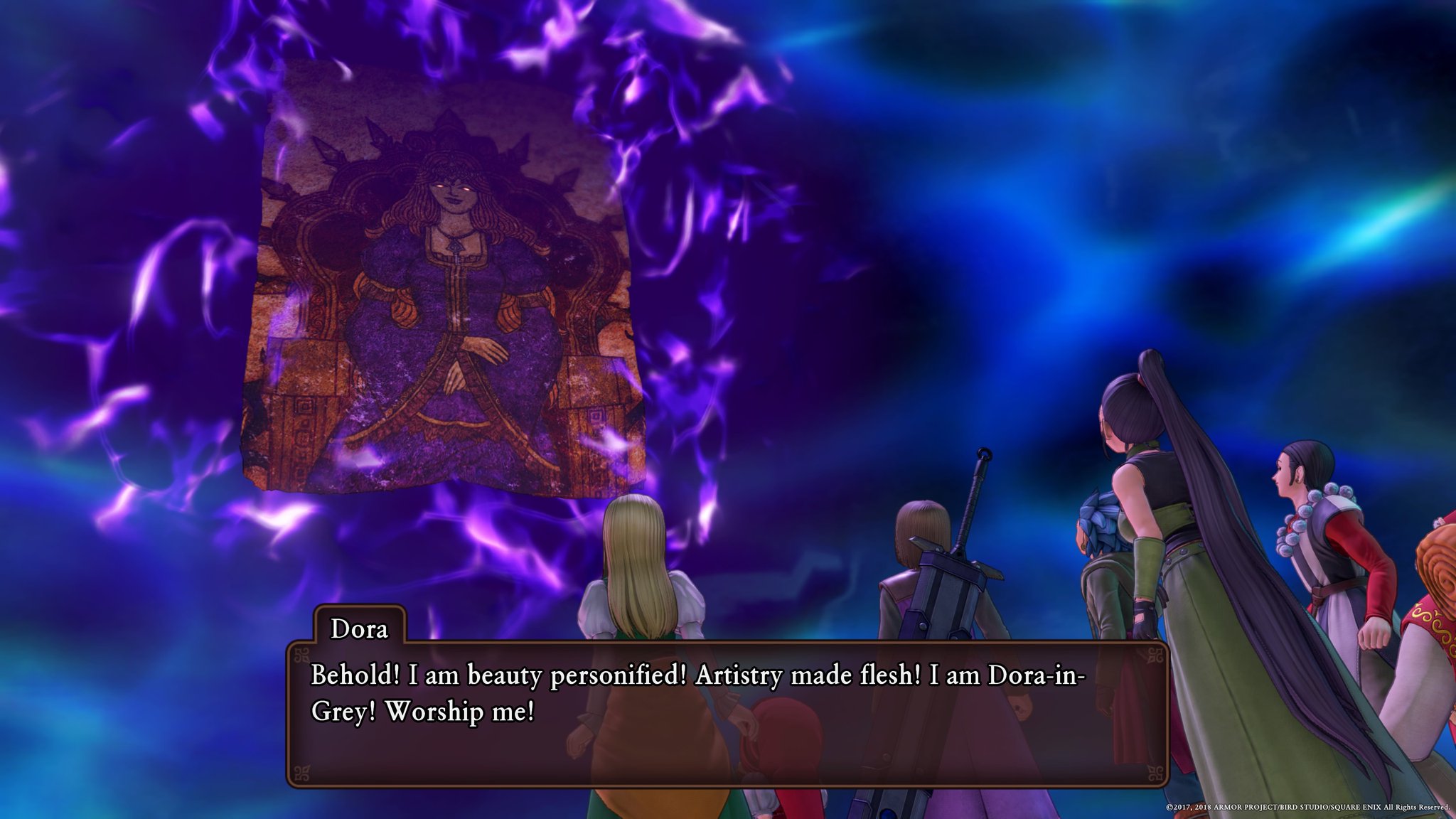
It wouldn’t be a JRPG if all bosses were serious. Sometimes you just have to fight a mural.

Overall this was a pretty enjoyable romp.  On the story front there wasn’t much new; this is still the story of a convenient hero creating a gang to take out the big world destroying baddy.  On the gameplay front it was mostly tweaks to the existing formula.  On the artistic side, it was a blend of the old and new.  However, the total package is one that really hasn’t been seen at this quality for what has been a genre moving into much different territory at the AAA level.  This may be the best example we’re going to see for a long time of a strictly turn-based JRPG, so I can’t do anything but strongly recommend it if that’s what you’re looking for.

Game Ramblings #67 – Radiant Historia: Perfect Chronology

More Info from Atlus

  • Genre: JRPG
  • Platform: 3DS
  • Original Released on: DS

TL;DR

  • Still one of the more interesting JRPG battle systems I’ve ever seen with a heavy emphasis on moving and grouping enemies for AoE attacks.
  • Good selection of new content for returning players that is well integrated into the mainline story for new players.
  • Doesn’t do anything to inherently fix the grind of the original game, but a new Friendly difficulty opens up some interesting potential for JRPGs to pull from.

Admittedly this is a game I shelved the first time around.  It’s not that it was bad; in fact its battle system alone makes this game at least worth checking out.  However, in the base difficulty this game is EXTREMELY grindy.  Fights are mechanically interesting, but can be slow.  Damage is large, so healing is often necessary.  Healing burns mana, so items are necessary.  Items cost money, so money is necessary.  Running out of money necessitates more fighting, so you’re stuck in a loop.  Generally speaking, it wasn’t even the bosses that were an inherent problem.  It was usually just getting to the point where taking out trash in a new chapter felt reasonable without being a huge risk.

So, does the remake solve that? Nope.  Does it do anything to really change the game mechanically?  Nope.  What it does so is add a new Friendly difficulty that is entirely too easy, but brings in some really interesting mechanics to eliminate the need to grind, and is something I hope to see more games explore in the future.

Combat is the core of any JRPG and this one is no different, cleverly mixing traditional turn-based mechanics with some tactical positioning systems.

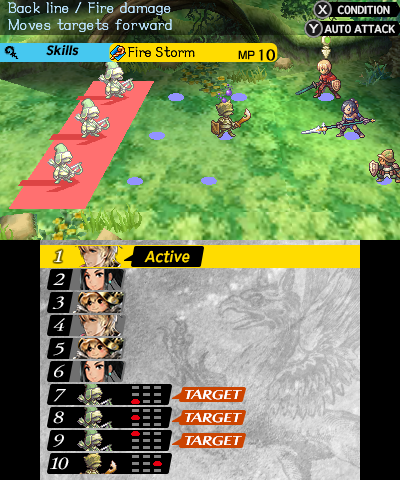
Since this is a JRPG, I feel like I should start off with combat as it was and still is one of the strong points of this game.  Radiant Historia pretty cleverly mixes pretty standard JRPG mechanics with a very tactics-styled positioning system into a quick hitting system where the focus becomes trying to maximize stacking of enemies to allow for multiple hits in one attack.

While the core system has your standards (basic attacks, magic attacks, heals, buffs/debuffs, etc), the real core of the system is in repositioning attacks.  Pretty early on all the party characters gain attacks that can move enemies around the board.  Enemies that are repositioned into each other are then treated as single units for purposes of attack location, allowing for stacked enemies to all be damaged at one time.  This then combines with turn order manipulation, either via speed stat, skills to delay turns, etc to chain friendly attacks, and the real focus comes down to basically trying to stack all enemies at once into a single spot and unleashing hell.

As an example, in the screenshot above, I could use Fire Storm to move the whole back line forward, then use line attacks to kill all 4 enemies at once.  Alternatively, I could push the front guy back and do the same against the full back line.  Other bonuses come into play (front line takes more damage but also does more damage) to allow for more nuanced strategies over the course of a full fight, but the core is in smart positioning for maximizing damage output.

All of these things elevate what would be a typically standard battle system into something truly special, and even in the grindy areas of the game allow for a lot of fun, particularly with the on-the-go nature of the DS family, allowing for a few interesting battles in a few minutes if that’s all the time the player has.

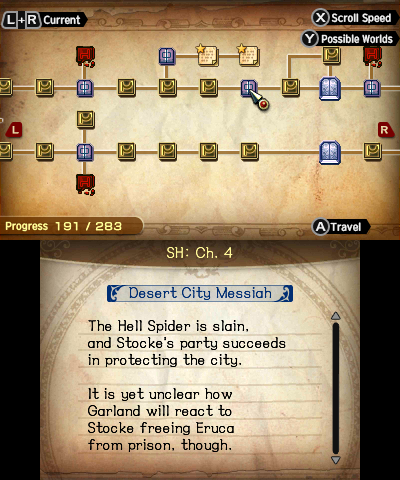
The core of the game is about free wheeling through time, with events in one timeline causing ripple effects on the other.

On the story side, this game is entirely about manipulation of time.  The game takes place in a split timeline where you have unlimited attempts to set things right, so dying is really not a huge deterrent.  However, each timeline has its own problems to solve, and problems that can unblock progress in the other timeline.  In addition, there are distinct losing points (red nodes in the above) where the story progress effectively ends, forcing a restart at the nearest chapter.

Overall this works as a good way for the player to have freedom in their choices.  Hit a block in the story and can’t figure it out? Find a spot where a new side path can be completed elsewhere in the timeline, and you might be able to unblock things.  Difficulty spike means you need to level up a bit? Jump back to an earlier point in the timeline where battle grinding is more practical.  The freedom of choice to jump around like that is a thing that a lot of JRPGs don’t really give, and its an effective tool here when combined with the story background of jumping through time.

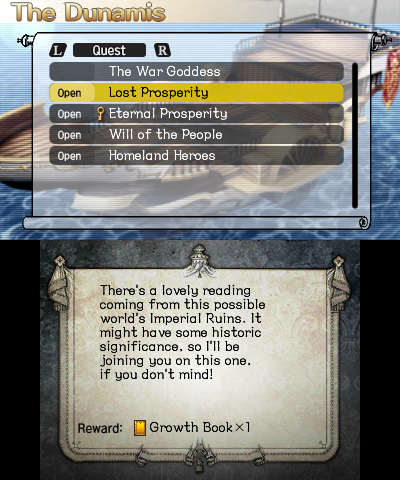
The Dunamis runs the set of side histories, adding new potential futures for the characters, as well as some additional back story to the world.

This is all maintained really well in the remake, and is padded by some additional new content both in the main timeline and in a new set of side stories labeled as possible histories.  For returning players, this is the bulk of the content that they’ll be coming back for.  While these aren’t story bits tied to the main line, they’re an interesting look at what could have been within the overall structure of the world.  In addition, the woman running the Dunamis also provides a path to learning more about the history of the world the game takes place in, opening a path for some more interesting lore.  However, this alone wouldn’t have been enough for me to come back for more grinding.  The addition of Friendly mode was the real thing that brought me back.

The entire idea behind Friendly mode is that it provides a path for the player to skip unimportant battles.  In the base game, if the player hits a unit on the field, they gain a preemptive strike to allow them to attack first in battle.  While this was helpful, it didn’t eliminate the need to spend resources while grinding.  Friendly mode takes this one gigantic step further.  In this mode, if the user strikes an enemy in the field, they automatically win the battle, gain XP, and gain all relevant resources that would have normally dropped.  The end result of this is that the only combat the player ever takes place in will be for boss battles and story-relevant battles, leaving the rest of the game to exist as a way to enjoy the story and figure out the time-based puzzles.

I’ve seen this mode described as the visual-novel version, and I think that’s about as close to accurate as I could come up with.  The game becomes significantly shorter in this mode, and the story comes at a much more rapid pace, so I found myself being significantly more involved in enjoying the story as it came at me, rather than having huge grinding delays between story segments.  It then felt even more important to be in battle, as it always felt like it served the story at that particular time, rather than being a consequence of needing to level up the party.

End of the day, I think this is something that more JRPGs should explore as a core feature going forward.  The reduction in grind meant the game flowed much quicker and I never lost the story.  If I WANTED to battle, I could also simply run into an enemy on the field and start battle, but it was a conscious choice.  The one real downfall of Friendly mode is that it was also combined with an extremely lowered difficulty.  Ideally, the Friendly mechanics would be combined with boss battles that are tied to the selected difficulty, leaving the challenge there where the player wants with the streamlined battle selection.  However, for a returning player simply wanting to see the story, I think the lowered difficulty ended up being pretty ideal for me in most areas.

I guess this is a pretty easy one for me.  This was a great game when it originally came out, and it’s a great game now.  The problems that existed are still there, so if you’re a new player be ready for some grinding.  If you’re a returning player, this is a <20 hour run with the addition of Friendly mode, allowing for the focus to be on enjoying the narrative.  However, I think there’s enough there for anyone to enjoy to generally recommend it, assuming of course you haven’t sold off your 3DS.